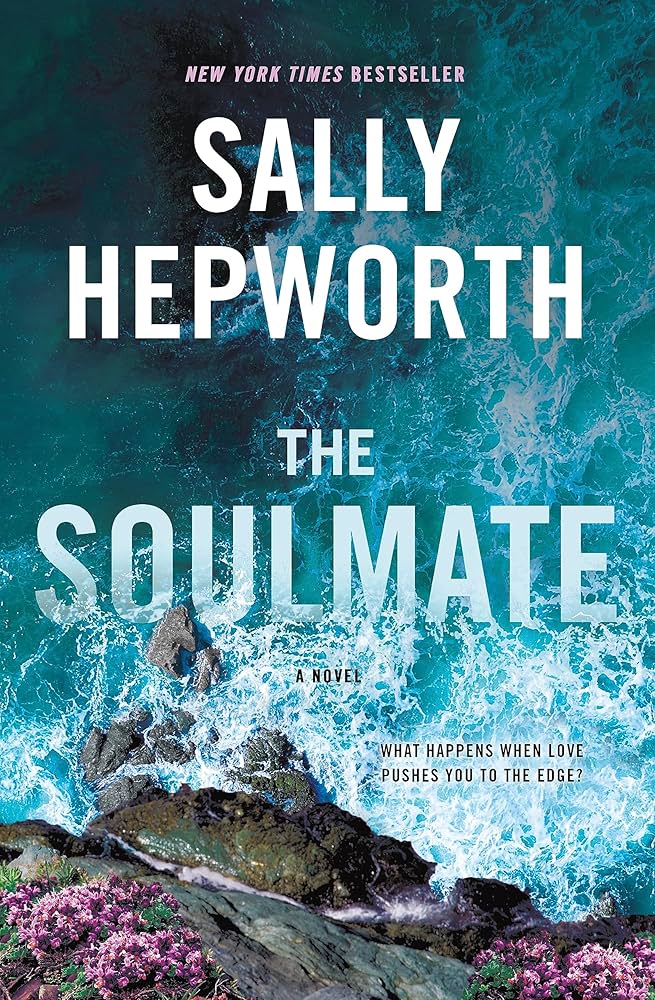
Author: Sally Hepworth
Genre: Psychological Thriller / Domestic Fiction
Ideal For: Readers who love emotionally intelligent thrillers that unravel slowly, dig deep into marriage and morality, and leave you questioning what you’d do to protect the people you love most.
Plot Summary (Spoiler-Free)
At first glance, The Soulmate feels deceptively serene. Gabe and Pippa Gerard live in a stunning cliffside home overlooking the ocean. Their life appears almost idyllic: a loving marriage, two young daughters, and a view that inspires awe every single day. But the cliffs they overlook are more than scenic—they’re infamous. People come here to end their lives.
Gabe has made it his quiet mission to watch the cliffs. When he sees someone standing too close to the edge, he intervenes, talking them down, staying with them until help arrives. He becomes known in the community as a hero, a saviour, a good man.
Until the night he doesn’t save someone.
When a young woman falls to her death, questions surface immediately. Did Gabe try to help her? Did he know her? Could he have stopped it? And most unsettling of all—why does Pippa feel that her husband might not be telling her everything?
What unfolds is a gripping, emotionally layered psychological thriller that explores love, loyalty, guilt, and the dangerous secrets that can hide inside even the strongest marriages.
Sally Hepworth’s Signature Strength: Emotional Realism
Sally Hepworth has long excelled at writing thrillers that aren’t driven by sensational twists alone, but by human psychology. In The Soulmate, she is at the height of her powers.
The novel alternates between two primary perspectives: Pippa in the present, grappling with the fallout of the death and her growing unease, and Amanda, the woman who fell, whose chapters reveal her life in the weeks leading up to her death. This dual structure creates a haunting tension—one voice searching for truth, the other slowly revealing it.
Hepworth’s writing is calm, controlled, and quietly devastating. She doesn’t rush the plot. Instead, she allows unease to build naturally, through half-glances, unasked questions, and the subtle ways trust begins to erode. The fear here isn’t explosive—it’s intimate. It’s the realization that the person you share a bed with might be a stranger.
Marriage as the Central Mystery
At its core, The Soulmate is not just about a death—it’s about marriage.
Pippa loves Gabe. She believes in him. She has built her life, her family, and her sense of safety around him. But when doubt creeps in, it’s not loud or dramatic. It’s insidious. A look that lingers too long. A story that doesn’t quite add up. A memory that suddenly feels rewritten.
Hepworth asks a devastating question: How well can you ever truly know your partner?
The novel examines the unspoken agreements couples make—the things we choose not to ask, the truths we quietly accept, the lies we forgive because the alternative would be unbearable. Pippa’s internal conflict is written with painful accuracy. She doesn’t want to uncover something terrible. She wants reassurance. She wants the story to end differently.
That tension—between truth and emotional survival—is where the novel truly shines.
Amanda: A Voice That Changes Everything
Amanda’s chapters are among the most powerful in the book. She is not portrayed as a mystery to be solved, but as a fully realised woman: intelligent, wounded, perceptive, and deeply lonely.
Through Amanda, Hepworth explores themes of emotional abuse, gaslighting, and the slow erosion of self-worth. Her storyline is heartbreaking not because of its ending, but because of how recognisable it feels. Amanda’s pain is quiet. Her suffering is easy to overlook. And that, perhaps, is the most unsettling part.
As readers, we come to understand Amanda in a way the world around her never did. Her chapters force us to confront how often people fall through the cracks—not because they weren’t loved, but because they weren’t seen.
The dual narrative ensures that Amanda is never reduced to a plot device. Her voice lingers long after the final page.
Suspense Built on Moral Ambiguity
Unlike many psychological thrillers, The Soulmate does not rely on constant shocks. Instead, it thrives on moral ambiguity.
Gabe is not an obvious villain. In fact, he is often kind, attentive, and loving. That’s what makes the doubt so effective. Hepworth understands that the most unsettling characters are not monsters—they are people who seem reasonable, even admirable.
As Pippa revisits moments from her marriage with new eyes, readers are invited to do the same. Was that kindness genuine? Was that omission innocent? At what point does protection become complicity?
The book never offers easy answers. Every character exists in shades of gray, and every decision carries consequences that ripple outward.
Themes That Linger
Trust and Complicity
The novel explores how trust can become a form of blindness. Loving someone often means choosing not to see certain things, and Hepworth challenges the idea that ignorance is always innocent.
The Cost of Silence
Both Amanda and Pippa are shaped by what they don’t say. The novel shows how silence—whether born of fear, loyalty, or exhaustion—can be as destructive as cruelty.
Hero Worship and Gendered Expectations
Gabe’s role as the “hero on the cliff” raises uncomfortable questions about how society rewards certain narratives while ignoring others. Who gets labeled a saviour, and who gets forgotten?
Motherhood and Moral Inheritance
Pippa’s fear isn’t just about her marriage—it’s about her daughters. What truths do we pass on? What lessons do children absorb when adults choose comfort over honesty?
The Pacing: Controlled and Confident
The Soulmate moves with a deliberate, almost hypnotic pace. Hepworth resists the urge to accelerate too quickly, allowing emotional stakes to deepen before revelations arrive.
Each chapter feels purposeful. Small details introduced early—a conversation, a glance, a recollection—return later with new meaning. The tension doesn’t spike suddenly; it tightens gradually, like a rope being pulled inch by inch.
By the time the final revelations unfold, they feel earned rather than sensational.
The Ending: Quietly Shattering
Without giving away spoilers, the ending of The Soulmate is both restrained and devastating.
Hepworth does not rely on dramatic courtroom scenes or over-the-top twists. Instead, she delivers an ending rooted in emotional truth. It’s the kind of conclusion that makes you sit in silence, replaying the story in your head, realising how carefully everything was constructed.
The final pages force readers to confront uncomfortable questions about morality, love, and responsibility. There is no neat resolution—only clarity, and the weight that comes with it.
Why The Soulmate Earns Five Stars
- Emotionally Intelligent – This is a thriller that understands human behavior at a deep level.
- Complex Characters – No caricatures, no easy villains—only flawed, believable people.
- Powerful Dual Narrative – Amanda’s voice elevates the novel into something unforgettable.
- Subtle, Sustained Suspense – Tension built on psychology, not gimmicks.
- Themes That Resonate – Marriage, trust, silence, and moral choice explored with nuance.
This is not a book you race through just to “find out what happens.” It’s a book you experience, absorbing its emotional weight and ethical questions long after you finish reading.
Final Thoughts
The Soulmate is Sally Hepworth at her most assured and compassionate. It’s a psychological thriller that understands that the scariest truths aren’t hidden in the dark—they’re right beside us, sleeping in the same bed, sharing our lives.
This novel doesn’t ask whether love can survive secrets. It asks whether love can survive the truth.
Quiet, unsettling, and profoundly human, The Soulmate is a standout in contemporary domestic thrillers—and a reminder that sometimes the greatest danger isn’t the fall from the cliff, but the ground we think is solid beneath our feet.