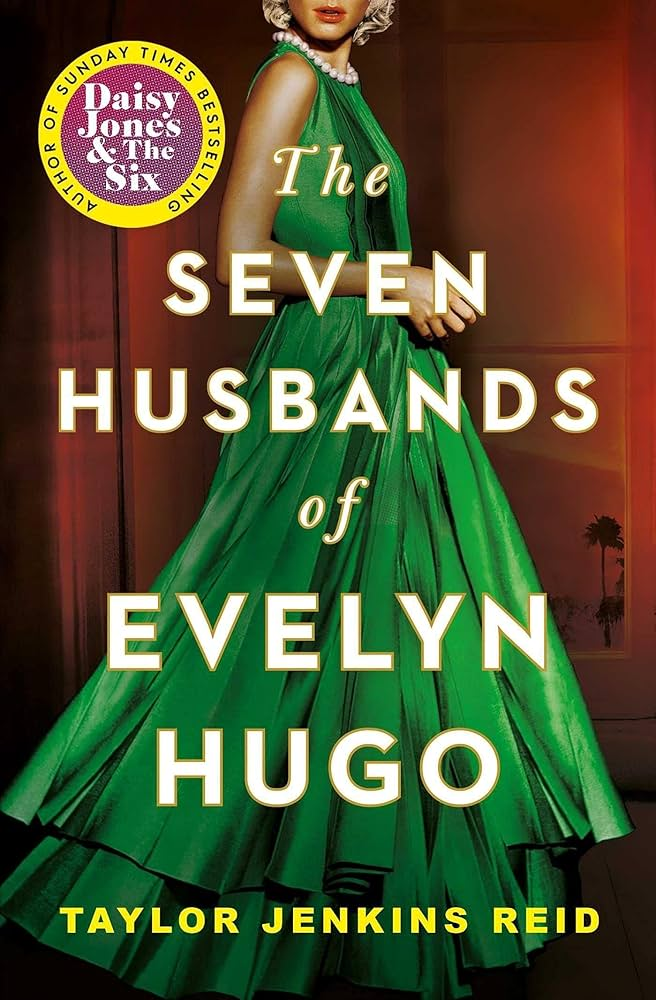
Author: Taylor Jenkins Reid
Genre: Historical Fiction / Contemporary Literary Fiction / Hollywood Saga
Ideal For: Readers who love emotionally rich character studies, stories about fame and identity, queer love stories told with nuance, and novels that feel both glamorous and devastatingly intimate. If you enjoy books that unfold like confessions and linger like memories, this one is essential.
Plot Summary (Spoiler-Free)
The Seven Husbands of Evelyn Hugo is framed as a revelation decades in the making. Evelyn Hugo, an aging and reclusive Hollywood legend, agrees to tell her life story—but only to Monique Grant, a relatively unknown journalist. The choice seems random at first. But as Evelyn begins recounting her rise from poverty to movie-star immortality, it becomes clear that nothing about this story is accidental.
Structured as a series of confessions, the novel traces Evelyn’s life through each of her seven marriages—relationships that the tabloids devoured but never truly understood. What unfolds is not a salacious celebrity memoir, but a deeply human story about ambition, love, sacrifice, and the price of survival in an industry that demanded women be beautiful, silent, and replaceable.
From the first page, Evelyn commands attention. She is unapologetic, sharp, and brutally honest. She tells Monique—and the reader—exactly who she was and why she did what she did, even when the truth makes her unlikeable. That honesty is the novel’s greatest strength.
Evelyn Hugo: A Character Who Feels Realer Than Reality
Evelyn Hugo is one of the most unforgettable characters in modern fiction. She is neither heroine nor villain—she is complicated, strategic, loving, ruthless, and vulnerable. Taylor Jenkins Reid crafts her not as a symbol, but as a fully embodied woman shaped by her time.
Evelyn’s marriages are not romantic milestones; they are survival strategies, love stories, compromises, and mistakes. Some husbands are stepping stones, some are shields, some are genuine companions. Each one reveals a different facet of Evelyn’s identity and the constraints placed on her as a woman, an immigrant, and a bisexual person navigating mid-20th-century Hollywood.
What makes Evelyn extraordinary is not her beauty or fame, but her clarity. She understands the cost of ambition and chooses to pay it—again and again. Yet Reid never lets her become cold. Beneath the glamour is a woman who loved fiercely, lost deeply, and lived with the consequences of every choice she made.
The Heart of the Story: Love That Couldn’t Be Public
At the emotional core of the novel is Evelyn’s great love—a relationship that could never exist openly in the world she inhabited. Without revealing spoilers, it’s enough to say that this love story is tender, devastating, and achingly real.
Reid writes queer love with reverence and restraint. It is not sensationalised or treated as a plot twist; it is simply a fact of Evelyn’s life, one that shaped everything else. The secrecy required to protect that love becomes both its shield and its undoing.
This is where The Seven Husbands of Evelyn Hugo transcends its Hollywood setting. It becomes a story about all the lives people live quietly, about the versions of themselves they hide in order to survive, and about the heartbreak of loving someone in a world that refuses to make space for you.
The love in this book is not perfect or pure—it is human. It is marked by jealousy, fear, loyalty, and regret. And because of that, it feels true.
Monique Grant: The Silent Counterpart
Monique’s role as interviewer could have easily felt secondary, but Reid gives her quiet depth. As Evelyn’s story unfolds, Monique is forced to confront her own life—her marriage, her career, her sense of worth. The parallel between the two women is subtle but powerful.
Monique represents a different generation, one with more freedom but still haunted by many of the same questions: How much of yourself do you sacrifice to succeed? Who gets to tell your story? What do you owe to the truth?
The eventual connection between Monique and Evelyn is one of the novel’s most satisfying elements. It reframes the entire narrative and adds emotional resonance without feeling contrived. Reid handles this revelation with precision and restraint, allowing it to land with full impact.
Themes That Give the Novel Its Weight
1. Ambition and Survival
Evelyn’s life is a case study in ambition—not the sanitized, motivational kind, but the messy, morally complex version. The book asks uncomfortable questions: Is ambition admirable when it requires compromise? Is survival a form of selfishness? Reid doesn’t offer easy answers.
2. Identity and Reinvention
Evelyn reinvents herself constantly—from poor Cuban immigrant to Hollywood goddess. Yet each reinvention costs her something. The novel explores how identity can be both chosen and imposed, especially for women whose bodies and images are commodified.
3. The Price of Secrecy
Secrecy runs through the book like a fault line. What we hide to protect ourselves can also isolate us. Reid captures the exhaustion of living a double life with quiet accuracy.
4. Public Myth vs. Private Truth
The contrast between who Evelyn was in the headlines and who she was in private is one of the novel’s most compelling tensions. It’s a reminder that celebrity narratives are often lies built on fragments of truth.
The Writing: Elegant, Accessible, and Immersive
Taylor Jenkins Reid’s prose is clean and controlled, allowing the story to shine without unnecessary ornamentation. The writing is accessible without being simplistic, emotionally rich without being overwrought. Dialogue feels natural, especially in the interview sections, which give the novel its confessional rhythm.
The structure—moving chronologically through Evelyn’s marriages while interspersing Monique’s present-day perspective—keeps the pacing tight. The book is remarkably difficult to put down, not because of cliffhangers, but because each chapter reveals a deeper layer of Evelyn’s truth.
Reid also excels at atmosphere. Old Hollywood feels tangible—the studio contracts, the press manipulation, the gender politics. Yet the novel never becomes a history lesson. The setting serves the story, not the other way around.
Why This Book Resonates So Strongly
Part of what makes The Seven Husbands of Evelyn Hugo so beloved is its emotional honesty. It does not romanticise fame or villainise ambition. It simply shows what it costs.
Readers connect to Evelyn because she is unapologetically herself—even when that self is flawed. She owns her mistakes. She doesn’t ask for forgiveness. She asks only to be understood.
The book also resonates because it reflects a universal truth: most people live more than one life within a lifetime. We are different versions of ourselves at different ages, in different relationships, under different pressures. Evelyn’s life is exaggerated by fame, but her struggles are deeply human.
The Ending: Bittersweet and Earned
The ending of the novel is emotionally devastating in the best way. It doesn’t aim to shock; it aims to complete the story. When Evelyn’s final truth is revealed, it reframes everything that came before it.
There is grief in the ending, but also peace. Evelyn’s story concludes not with redemption or punishment, but with understanding. It honors the life she lived—not the one the world thought it knew.
Few books manage to end in a way that feels both surprising and inevitable. This one does.
Why It Deserves Five Stars
This is a five-star novel because it succeeds on every level:
It delivers a compelling, page-turning narrative.
It creates a protagonist who feels real enough to step off the page.
It explores love, identity, and ambition with emotional intelligence.
It handles queer storytelling with respect and depth.
And it leaves a lasting emotional imprint.
The Seven Husbands of Evelyn Hugo is not just a story about Hollywood—it’s a story about what it means to live fully, love deeply, and accept the cost of being yourself.
Final Thoughts
Taylor Jenkins Reid has written a modern classic. The Seven Husbands of Evelyn Hugo is the kind of book that readers press into friends’ hands and say, “You have to read this.” It invites obsession, reflection, and emotional investment in equal measure.
Long after you finish the final page, Evelyn Hugo remains with you—her voice, her choices, her unapologetic truth. She feels like someone who once lived, loved, and left behind a story that deserved to be told properly.
This novel is a reminder that behind every myth is a human being, and behind every headline is a truth far more complicated—and far more beautiful—than we ever imagine.
Verdict: A luminous, heartbreaking, and unforgettable novel about love, ambition, and the stories we tell to survive.