Author: Suffian Hakim
Genre: Contemporary Fiction / Satire / Magical Realism
Ideal For: Readers who enjoy sharp, quirky Singaporean stories that blend humour with social commentary. Perfect for anyone who loves unconventional narratives, multicultural casts, and satire that isn’t afraid to poke fun at politics, race, and national identity. Also great for readers who want distinctly Singaporean fiction that still feels universally relatable and emotionally resonant.
Introduction
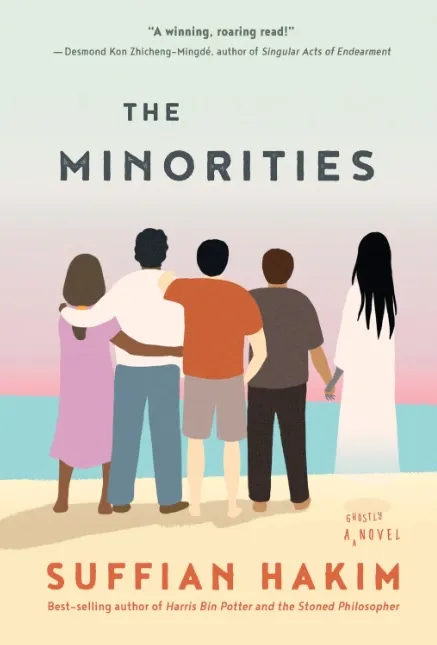
Suffian Hakim’s The Minorities is one of those rare novels that manages to be laugh-out-loud funny, wildly imaginative, and emotionally devastating all at once. On the surface, it reads like a supernatural road trip starring a hapless Malay protagonist, a China-born housemate with questionable visa status, a pontianak who doesn’t want to commit murder anymore, and a Bangladeshi worker with secrets of his own. But under the absurdity, Hakim constructs a breathtakingly sharp critique of race, belonging, and the fragile, funny thing we call “Singaporean-ness.”
This is a story that doesn’t just entertain — it interrogates. It pokes, prods, and lovingly mocks the stories we tell about multicultural harmony, shining light on the minorities within minorities. The result is a novel that feels uniquely, unmistakably Singaporean: chaotic, fast-paced, self-aware, and emotionally honest.
The Minorities isn’t just a book. It’s a mirror held at an angle — one that shows the nation’s quirks with humour and ache, revealing not only what we are, but what we fear becoming.
Plot Summary (Spoiler-Free)
Our narrator, an unremarkable Malay boy with a string of unfinished ambitions, inherits a flat in Eunos after his mother’s death. What starts as a simple move spirals into the most bizarre of living arrangements: he finds himself cohabiting with:
— Safari, a melancholic pontianak trying to break free from her violent nature,
— Ting, a blunt Chinese national obsessed with hustling his way to stability, and
— Ibrahim, an undocumented worker whose quiet presence hides a heart-breaking story about displacement.
When a tragic accident sets them on the run, the four misfits embark on a journey across Singapore — and eventually beyond its borders — in search of safety, redemption, and a sense of home.
It’s absurd. It’s unpredictable. And it’s brilliant.
Hakim blends satire, magical realism, cultural lore, social commentary, and buddy-comedy energy into a story that constantly reinvents itself. The pacing is wild in the best possible way, unfolding like a Netflix series you binge until sunrise because every chapter leaves you craving the next.
A Voice That Knows Exactly What It’s Doing
Hakim’s writing is sharp — comedic without trying too hard, introspective without being self-pitying. His sentences often hit with the rhythm of spoken word, and his humour comes from honesty rather than exaggeration.
The narrator’s voice is chaotic, self-deprecating, and deeply human. He is simultaneously aware of his failures and unable to escape them. Hakim uses this voice to great effect, exposing generational trauma, racial anxieties, and the crushing expectations placed on minority youths in Singapore.
And yet, nothing feels heavy-handed. You laugh even when your chest aches. You keep turning the pages because Hakim’s voice — bold, cheeky, and vulnerable — feels like someone you know personally.
Characters Bursting With Life (Even the Dead Ones)
The characters are the heartbeat of The Minorities, and each one is a masterpiece in voice and complexity.
Safari — The Pontianak With a Conscience
Safari may be a legendary Malay vampire, but Hakim strips away myth to reveal something tender: a woman haunted not by the living, but by her own capacity for violence. Her longing for freedom from her nature becomes one of the novel’s most poignant arcs.
Ting — The Hustler Hangzhou Would Be Proud Of
Ting is loud, unapologetically ambitious, and brutally practical — traits often caricatured in fiction but given unexpected nuance here. He represents economic migration, the hunger for survival, and the loneliness of being unwanted in a place you want to call home.
Ibrahim — The Quiet Soul With the Loudest Story
In Ibrahim, Hakim crafts a gentle yet devastating portrait of the migrant worker experience. His kindness, fear, and dignity break your heart in slow motion. His arc is quiet but unforgettable.
Our Narrator — A Reluctant Witness to His Own Life
He is the “average minority male” — a trope Hakim refuses to leave unchallenged. His grief, frustration, and yearning for direction become the emotional spine of the story.
Their chemistry together is electric — chaotic, comedic, and carved out of necessity rather than choice.
A Singapore Rarely Seen in Fiction
The Minorities succeeds because Hakim dares to show parts of Singapore that mainstream narratives often avoid. The underbelly of migrant labour. The discomfort of being visibly different. The tensions that simmer beneath neatly packaged slogans about harmony.
Hakim highlights:
- the power imbalances between majority and minority citizens
- the ghostly presence of folklore in modern life
- the loneliness of living in a city obsessed with success
- the fragility of safety for those without the “right papers”
- the way humour becomes survival for the marginalised
He captures Singapore’s contradictions with affection — the rigid order hiding messy realities, the obsession with progress overshadowing compassion, the belief in multicultural harmony while harbouring quiet prejudices.
There are passages so sharply observed that you can practically hear a kopitiam uncle muttering in the background.
Humour as a Weapon, Comfort, and Bridge
Hakim understands that humour can do what lectures cannot. Through jokes, absurdity, and biting satire, he disarms readers, making them receptive to uncomfortable truths.
The comedy here is uniquely local. It’s recognisable to anyone who has lived on the island — the deadpan sarcasm, the way people soften harsh realities by turning them into punchlines, the specific rhythm of Singlish that wraps tragedy in levity.
But this humour never trivialises the pain beneath it. Instead, it reveals how minorities cope with trauma: by laughing at the system that tries to flatten them.
A Road Trip That Becomes a Journey Inward
The story’s physical journey — the group’s desperate escape across the country — mirrors their emotional paths. As they visit hidden corners of Singapore rarely depicted in fiction, each character confronts personal demons:
Safari examines her nature. Ibrahim wrestles with belonging. Ting faces the cost of being disposable labour. The narrator faces his grief, self-hatred, and longing for purpose.
Their collective flight becomes a meditation on what makes a home: safety? belonging? shared struggle? memory?
Hakim suggests that home is not a place but a fragile connection between people who choose each other despite the odds.
Themes That Hit Hard and True
1. Race and Belonging
Hakim dissects the complexities of minority identity with precision. He doesn’t settle for easy binaries or stereotypes; he exposes internalised racism, community rivalries, and the nuanced emotional architecture of being “the other” in your own home.
2. Migration and the Invisibility of Certain Lives
Ibrahim’s storyline is a subtle but devastating critique of Singapore’s reliance on migrant labour. Hakim gives voice to the voiceless, reminding readers that behind every construction site lies a story.
3. Folklore as Cultural Memory
Safari’s presence is more than supernatural flair. She represents the ghosts of cultural memory — mythologies that shape identity, warn against danger, and hold historical trauma.
4. Mental Health and Masculinity
The narrator’s emotional paralysis, his self-loathing, and his inability to articulate grief mirror the experiences of many young men taught to “tahan” (endure) instead of feel.
Hakim’s Prose: Hilarious, Poetic, and Utterly Singaporean
Hakim writes with a rhythm that feels like sitting at a hawker centre listening to your funniest friend tell the world’s most tragic story while slurping mee goreng.
His sentences can be absurdly funny one moment and heartbreakingly lyrical the next:
Comedy sharpens critique. Poetry softens brutality. Singlish grounds everything in local authenticity.
The prose makes you laugh, then leaves you staring at a sentence that suddenly feels like a punch to the chest.
Why It Deserves Five Stars
The Minorities earns every one of its stars because it dares to be everything at once — comedic, tragic, political, tender, supernatural, and deeply human. Hakim refuses to write neatly, and that refusal is the book’s triumph.
It’s rare to find a novel that:
- captures a nation’s identity without forcing propaganda
- uses humour to reveal rather than hide truth
- treats marginalised characters with dignity entertains while challenging assumptions
- embraces chaos as a form of authenticity
Hakim achieves all this with confidence, compassion, and an unmistakable sense of voice.
This is not a book you simply read; it’s a story that lingers, reshapes you, and continues whispering long after the last page.
You’ll Love This If You Enjoy…
Satirical, Smart, and Unapologetically Absurd Asian Fiction
If you love novels that take everyday cultural quirks and amplify them into sharp, satirical joy, The Minorities will be exactly your flavour. Think Kevin Kwan’s Crazy Rich Asians—but weirder, wilder, and wonderfully Singaporean. Hakim’s humour is more irreverent and surreal, but if you enjoyed Kwan’s blend of wealth, identity, and high-octane comedy, you’ll feel right at home.
Books That Explore Multicultural Identity With Heart (and Laugh-Out-Loud Chaos)
Readers who adored R.F. Kuang’s Yellowface or Souvankham Thammavongsa’s How to Pronounce Knife will appreciate how The Minorities plays with identity politics, belonging, and outsider-ness. Hakim tackles these themes with humour instead of solemnity, but the emotional undercurrent will feel familiar to fans of diaspora stories.
Absurdist Fiction That Still Delivers Emotional Punches
If you enjoy novels that bend reality while revealing uncomfortable truths—like Han Kang’s The Vegetarian or Sayaka Murata’s Earthlings—you’ll love how Hakim flips between ridiculous and profound. He’ll make you laugh at one sentence and sit in quiet reflection the next.
Singapore Stories Told With Grit, Wit, and Magic
Fans of Balli Kaur Jaswal’s Sugarbread or Alfian Sa’at’s Malay Sketches will appreciate Hakim’s hyper-local references, linguistic play, and keen observations on class, race, and belonging in Singapore. His style is louder and more chaotic, but the cultural resonance is just as powerful.
Found-Family Narratives With Quirky Charm
If you melted over the ragtag crews of Fredrik Backman’s A Man Called Ove or TJ Klune’s The House in the Cerulean Sea, you’ll adore the strange, mismatched group in The Minorities—each one an outsider, each one unexpectedly lovable.
Magical Realism That’s Whimsical Without Losing Its Bite
Readers who love the imaginative sparkle of Haruki Murakami’s Kafka on the Shore or Leslie Marmon Silko’s Ceremony will appreciate how Hakim uses magical realism to explore alienation, migration, and belonging—all through a uniquely Singaporean lens.
Humorous Fiction That Doesn’t Hold Back
If you’re into the unapologetic, snappy humour of Samantha Irby, David Sedaris, or Jesse Q. Sutanto’s Dial A for Aunties, Hakim’s comedic rhythm will be a delightful hit. His jokes are sharper, often political, and sometimes outrageous, but undeniably entertaining.
Final Verdict
Five stars — a bold, brilliant, unforgettable novel that is as funny as it is fierce.
Suffian Hakim’s The Minorities is a masterpiece of modern Singaporean fiction: satirical, supernatural, and profoundly moving. It is a celebration of misfits, a critique of society, and ultimately a love story about unlikely belonging.
Whether you come for the humour, the folklore, the politics, or the sheer absurdity, you’ll stay for the beating heart at the centre of it all — a reminder that often, the families we choose save us more than the ones we’re born into.