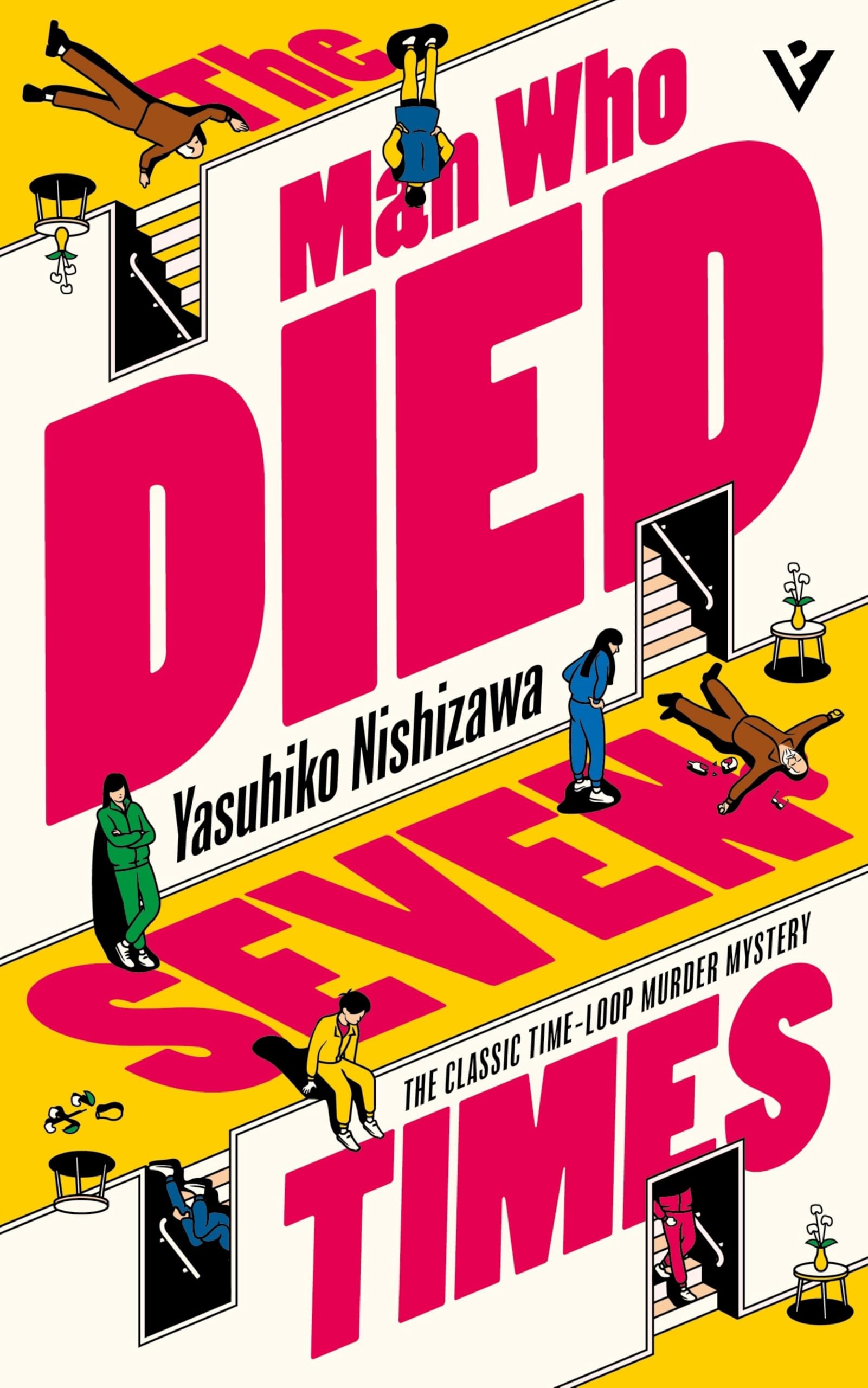
Author: Yasuhiko Nishizawa (translated by Jesse Kirkwood)
Genre: Mystery / Time Loop / Literary Puzzle Fiction
Ideal For: Readers who adore inventive mysteries, time-loop narratives like Groundhog Day, and character-driven whodunits with a unique twist. The Man Who Died Seven Times is also a perfect pick for fans of classic locked-room puzzles updated with speculative flair.
Plot Summary (Spoiler-Free)
The Man Who Died Seven Times opens on New Year’s Day in the grand, somewhat chaotic mansion of the Fuchigami family. A wealthy patriarch, Reijiro Fuchigami, intends to announce who among his children and grandchildren will inherit his fortune. But before he can do so, he is found dead — apparently murdered. It’s a setup familiar to mystery lovers: a family with secrets, a sprawling household, and motives aplenty. What makes this story extraordinary, however, is its ingenious time-loop twist.
The protagonist is Hisataro, Reijiro’s sixteen-year-old grandson, who has a peculiar affliction: certain days of his life repeat themselves nine times in a row — a phenomenon he dubs “the Trap.” On this fateful New Year’s Day, Hisataro enters the Trap just as his grandfather is killed, reliving the same day over and over. Each cycle gives him another chance to observe, deduce and perhaps change the outcome — but solving a family murder proves far trickier than merely observing it.
A Clever Conception That Breathes New Life Into the Locked-Room Mystery
What Nishizawa achieves here is more than a mere gimmick; he reimagines the classic locked-room mystery through a recursive structure that propels the narrative. Each loop isn’t just repetition — it’s revelation. The more Hisataro relives the day, the more layers he peels back from the family façade: resentments, alliances, vanities and hidden histories begin to crystallise.
Despite the central conceit of repeating days — a setup that might feel redundant in lesser hands — the book uses each iteration to shift perspective, subtly alter events, and accelerate our understanding of the mystery. It turns the narrative into a puzzle box where each layer, each repeat of the hour, nudges you closer to the heart of the truth.
The time loop gives the reader a feeling similar to watching a sleuth reset and re-observe a crime scene again and again, but more intimate: we know everything Hisataro knows, and so do you, the reader. This shared perspective creates a kind of immersive detective experience — equal parts intellectual challenge and emotional investment.
Hisataro: A Different Kind of Hero
Hisataro isn’t a genius detective in the classical mold; he’s introspective, earnest, and a touch resigned to his unique condition. His repeated cycles have made him wary of forming deep emotional attachments and keenly philosophical about life’s meanings. Yet, when faced with murder in his own family, he approaches the mystery with persistence rather than bravado.
His voice carries the narrative’s dry humor — wry observations about his family’s eccentricities, his own fatalism, and the mechanics of a day unwilling to end. And while he doesn’t undergo radical personal transformation by the end, his perspective deepens as he begins to see his ability less as a burden and more as a unique gift.
The ensemble cast of relatives and household staff create a vibrant backdrop of motives, secrets and shifting alliances. Some characters lean into comic absurdity, others into true menace, but collectively they form a tapestry of interpersonal tension that keeps the reader guessing.
Plot That Balances Puzzle With Entertainment
Nishizawa, part of Japan’s shin-honkaku (new orthodox) mystery movement, leans into the mystery’s structural ingenuity without ever letting the narrative become convoluted or emotionally cold. Every loop of the day reveals something new — not just evidence but nuance of character and intention.
True to the best traditions of mystery fiction, there’s an architectonic elegance here: clues are placed thoughtfully, red herrings are entertaining, and the information that matters is revealed at exactly the right moment. The time-loop device allows the narrative to experiment with cause and effect in inventive ways. Each iteration brings us closer — sometimes by refuting earlier assumptions, sometimes by catching smaller details that seemed innocuous before.
Suspense accumulates not through frantic action but through intellectual escalation. Some readers may find the repetition inherently challenging, but the clever structuring ensures that each repeated cycle feels fresh, provocative — a crucial achievement in a book built around the same day repeating itself nine times.
Writing Style and Translation: Clear, Engaging, Accessible
Translated by Jesse Kirkwood, the prose is lucid and accessible, prioritising clarity of momentum over lyrical flourishes. This stylistic choice suits the puzzle-centric plot; readers are never bogged down by overly ornate language, yet the text retains just enough personality to keep the voice engaging.
The narrative’s rhythm mirrors the looping structure, moving briskly between observation and deduction. The tone swings between playful and suspenseful in equal measure — sometimes evoking wry amusement at a relative’s absurd behaviour, sometimes tightening into a knot of tension as motives and means begin to coalesce.
Themes: Time, Family, and the Mechanics of Memory
Beneath its clever surface, The Man Who Died Seven Times is also a meditation on family dynamics and the nature of time. The setting itself — a sprawling family gathering with all the awkwardness, competition and hidden tensions that implies — is fertile ground for mystery. The loops force Hisataro (and the reader) to confront the same relationships from different angles, repeatedly.
The narrative invites us to question how much behavior is determined by circumstance versus choice. Each day offers the chance to observe a reaction, provoke a new response, or create a small deviation. This echoes deeper human questions about regret and optimisation — if given a chance to relive moments, what changes would we make? What truths might reveal themselves?
The family’s inheritance dispute serves not merely as motive fodder but as a commentary on legacy and desire. Wealth, status, affection — what do we truly value, and how far will we go to secure it? The time loop intensifies these questions, burying them under layer after layer of repeated opportunity.
Why It Earns Five Stars
The Man Who Died Seven Times earns its five-star rating for its brilliant fusion of classic mystery structure with speculative imagination. Its clever time-loop mechanism isn’t just an entertaining conceit — it’s central to how the puzzle unfolds and how characters are revealed.
The pacing is balanced, looping without feeling stagnant, and each repetition brings new insight. Nishizawa’s plotting is meticulous, and while the narrative doesn’t stray into high emotional drama, it rewards patient readers with satisfying cognitive engagement. The tone dances between smirking humour and tense intrigue, creating a refreshing whodunit that doesn’t take itself too seriously, yet never cheats its own rules.
The secondary benefit of this novel is its place as a translated work introducing English-language audiences to a distinctive facet of Japanese mystery fiction. It stands as a testament to how mystery conventions can be revitalised with speculative flair and cultural texture.
A Few Gentle Caveats
While the book is captivating, readers who prefer deep character arcs or emotionally complex protagonists may find the emotional continuity flatter than they’d hoped. Much of the focus is on the puzzle itself, and while that’s exhilarating in its own way, emotional payoff sometimes plays second fiddle to structural ingenuity. Even so, this feels less like a flaw and more like a stylistic choice — one that aligns with the novel’s genre ambitions.
Some cultural elements and character behaviours might feel unusual or puzzling to readers unfamiliar with Japanese mystery tropes or family drama conventions, but these quirks mostly add color rather than confusion.
Why Fans Will Love It — And Why Newcomers Should Too
If you’re drawn to mysteries that make you think, if you relish stories that reward careful attention, and if you enjoy narrative ingenuity that respects the reader’s intelligence, The Man Who Died Seven Times is a delight. It’s not just a book you read; it’s a puzzle you inhabit. Its repetitive day cycle becomes immersive rather than monotonous, and every iteration feels like a chance to see the story from a sharper angle.
It’s the kind of book that invites conversation: How would you spend a day on loop? What would you notice only after seeing it nine times? And which secrets lie hidden in plain sight? The novel answers these questions with wit, clarity, and quirky spirit.
Verdict: Ingenious, fun, and unforgettably clever, The Man Who Died Seven Times redefines the mystery genre with a narrative premise so bright and refreshing that it feels inevitable in hindsight. If you’re looking for a mystery that’s playful yet exacting, speculative yet grounded in human observation, this novel is absolutely worth your time.