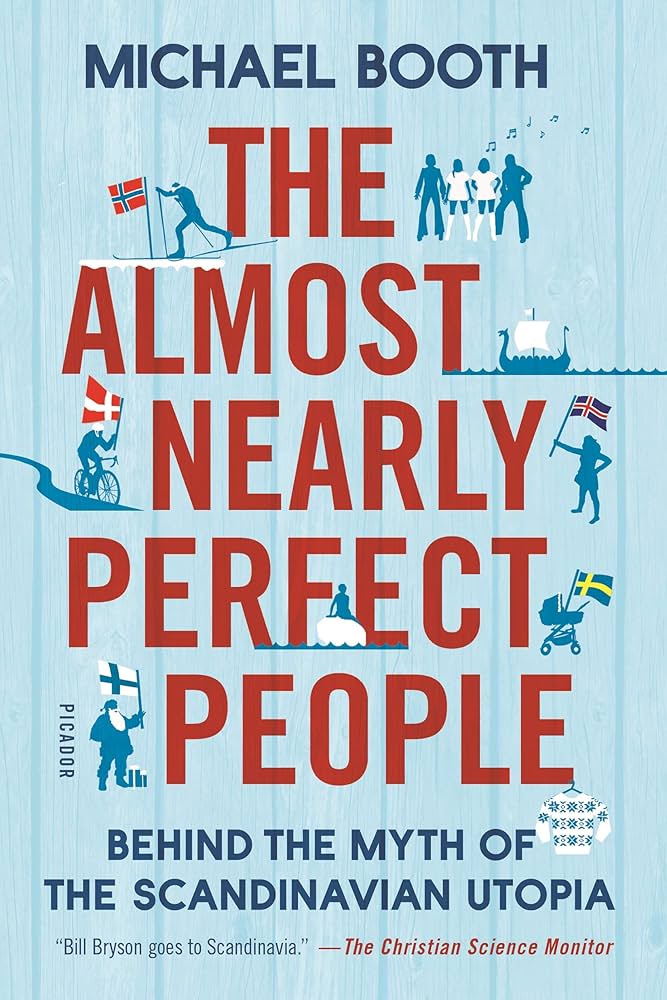
Author: Michael Booth
Genre: Non-fiction / Travel-Cultural Critique
Ideal For: Anyone curious about the so-called “Nordic miracle,” the inner workings of the world’s happiest countries, and the messy realities behind Scandinavian perfection. Perfect for fans of Bill Bryson’s travelogues, Tyler Cowen’s explorations of national character, or anyone with a curiosity about how societies actually function when you scratch beneath the surface.
Introduction
The very title of the book — The Almost Nearly Perfect People — strikes a clever tone: this isn’t about celebrating flawless utopias, but about interrogating them. Michael Booth, a British journalist who has lived in Denmark for years, sets off on a big, bracing tour through the Nordic countries (Denmark, Norway, Sweden, Finland, Iceland) to ask how these societies really work — and whether the global hype around them holds up. He turns the notion of “Scandinavia = perfection” on its head just enough to make you rethink everything you thought you knew.
This is a book that’s at once witty, erudite, irreverent—and kind of comforting in its honesty. Booth doesn’t write from a lofty perch; he writes from the inside-outsider vantage: married into a Dane, resident in Copenhagen, yet still probing with the curious skepticism of a traveller. The result is both entertaining and thought-provoking.
A clever structure with plenty of flavour
Each chapter focuses on one country, and each country gets its quirks dissected: Danish “hygge” and conformity, Iceland’s wild banking collapse and elf-beliefs, Norwegian oil wealth and social contradictions, Finland’s “sisu” and stoicism, Sweden’s social-democratic legacy and immigration tensions. Booth peppers the narrative with chapter titles like “Elves,” “Dirndls” and “Somali Pizza”—which hint at both his playful tone and the odd cultural details he delights in.
While flying through countries, Booth displays a knack for data, history, and anecdote in rich measure: tax rates, debt levels, happiness indexes, drinking habits, welfare systems, and national stereotypes. He folds them together with the kind of breezy narrative that keeps you flipping pages. At the same time, the reader gets enough substance to feel like this is more than a superficial travel diary. For example, he notes that Danes have among the highest taxes in the world, yet manage to score high on happiness.
Sharp humour, genuine affection
What makes this book stand out is Booth’s voice. He writes with wry humour and no small measure of self-awareness. He doesn’t parrot the myth of Nordic perfection — instead, he pokes it, teases it, and ultimately respects it. He sees the contradictions: how societies famed for equality also cultivate conformity; how the richest nations also grapple with social malaise; how myth and reality intertwine.
His observations are merciless in their candour but rooted in affection. He remains clearly fascinated by his subject; he wants to understand it, not simply dismiss it. That blend of critique + curiosity gives the book its vitality. One reviewer called it “a lively exploration…driven by genuine curiosity and appreciation for a singular part of the world.”
What you’ll take away
By the end of the book you’ll have learned a lot. You’ll understand why the Danes might appear happy yet carry heavy debt; why Iceland in its fragility reveals deep national identity shifts; why Norwegians wrestle with oil-rich comfort and social responsibility; why the Finns’ stoicism and “sisu” hide quiet psychological burdens; and why Sweden’s social model, in all its success, still encounters cultural friction.
But more than facts, you’ll gain a more layered perspective on what societies can offer, what pressures they hide, and how national character is always more messy than headlines suggest. Booth forces you to ask: how much do systems, culture, history, and personality intertwine to shape a society? And what happens when the world treats one model as “ideal”?
My few caveats
While I found the book thoroughly engrossing, there are a few minor caveats worth noting—though none of them dim the overall achievement.
First: the lens is heavy on the anecdotal and journalistic. As some critics point out, Booth’s reliance on quirky encounters and sharp observations sometimes gives the impression of “travelogue meets commentary” more than rigorous social science. If you’re looking for deep academic analysis, this isn’t it—but if you’re looking for thoughtful, readable insight, you’ll be very satisfied.
Second: the coverage of the countries isn’t entirely even. Denmark understandably gets the most attention (given Booth’s residence), while others feel more condensed. You might feel that some chapters skim over complexities that deserve fuller exploration. One reviewer noted that Iceland and Norway “felt one-dimensional” in places. But again: for the book’s ambition—to entertain and provoke rather than exhaust—this is acceptable.
Third: the tone occasionally flirts with cheeky irreverence. Some might find it a little too wry or lightweight for the gravity of the issues (immigration, welfare, inequality) he raises. But I felt the tone traded dryness for accessibility in a smart way.
Why this book matters
We tend to hold up the Nordic countries as models: for happiness, equality, welfare, life-balance. But the very fact that we treat them as models means we risk overlooking the trade-offs, the contradictions, the lived realities of those societies. Booth’s book reminds us that no society is flawless, and that the “miracle” comes with its own compromises.
In an era of global comparisons, populist backlash, and social experimentations, The Almost Nearly Perfect People gives us a useful mirror: not to fawn, but to reflect. It says: yes, these societies offer extraordinary achievements—but they are human. They struggle. They conform. They question. And they face their own dilemmas.
For anyone fascinated by how societies work — how systems shape lives, how culture and history wrap around policy and psychology — this book delivers. And it does so with wit, readability, and genuine insight.
Final verdict
The Almost Nearly Perfect People earns its five-star rating not because it’s flawless, but because it hits exactly the right balance of intelligence, humour, critique, and affection. Booth invites you into northern Europe’s myths and realities, challenges your assumptions, and leaves you richer in understanding (and maybe a little more surprised).
Whether you already know a lot about Scandinavia or bring only curiosity, this book will grip you, teach you, make you laugh, and make you think. In short: read it. Then perhaps look north differently.