Author: Vivian Tu
Genre: Personal Finance / Money Mindset / Self-Development
Ideal For: Anyone who feels overwhelmed, excluded, or intimidated by traditional finance advice—and wants a modern, empowering, no-nonsense approach to money that actually fits real life.
Introduction
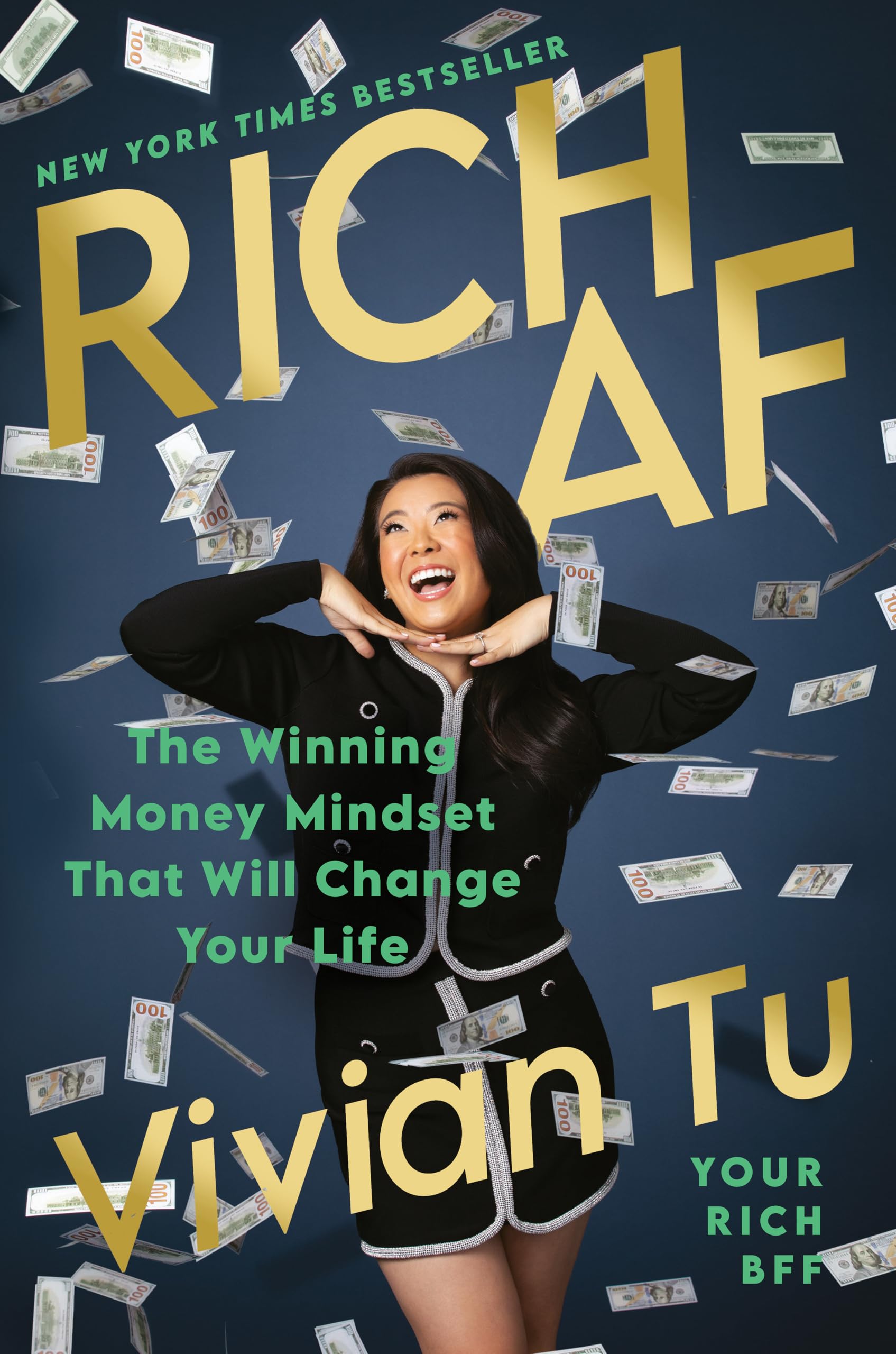
Rich AF: The Winning Money Mindset That Will Change Your Life does something rare in the crowded personal finance genre: it doesn’t just teach you what to do with money—it explains why you’ve been taught to feel the way you do about it in the first place.
Vivian Tu, also known as “Your Rich BFF,” writes from the perspective of someone who has lived on both sides of the financial divide. She understands the anxiety of not knowing, the shame of feeling behind, and the frustration of advice that assumes you already have a safety net. This book is built for readers who were never taught the rules of money—but are more than capable of mastering them.
From the opening chapters, it’s clear that Rich AF isn’t about guilt, restriction, or hustle culture. It’s about clarity, power, and confidence. Tu doesn’t talk down to the reader. She speaks with them—often with humour, sometimes with righteous anger, but always with intent.
The Core Promise: Money Is a Tool, Not a Moral Test
At its heart, Rich AF argues that money is not a reflection of your worth, intelligence, or discipline. It is a system—one that can be learned, questioned, and optimised. This framing alone makes the book feel radically different from traditional finance guides that lean heavily on shame or moralizing.
Tu dismantles the idea that being “bad with money” is a personal failure. Instead, she shows how systemic gaps, cultural silence, and inaccessible education have kept many people—especially women and marginalised communities—from financial confidence.
The book’s thesis is simple but powerful: once you understand how money actually works, you can make decisions from a place of strength rather than fear. Wealth, in this context, isn’t about being flashy or “rich” in the stereotypical sense. It’s about optionality. Safety. Freedom.
A Mindset-First Approach That Actually Works
Unlike many finance books that jump straight into budgets and spreadsheets, Rich AF starts where most people actually struggle: mindset.
Tu explores how beliefs about money are formed—through family narratives, cultural expectations, and social conditioning—and how those beliefs quietly shape financial behaviour. Whether it’s fear of investing, guilt around spending, or the belief that wealth is “not for people like me,” these internal barriers are treated as seriously as external financial tactics.
This emphasis on mindset doesn’t feel abstract or fluffy. It’s deeply practical. Each insight is tied back to behavior: why people avoid opening bank statements, why they under-negotiate salaries, why they over-save out of fear or under-save out of denial. Tu shows that fixing money problems often starts with rewriting internal scripts.
The result is a book that feels emotionally intelligent as well as financially sound.
Clear, Practical Advice Without the Intimidation
Once the foundation is set, Rich AF moves into the mechanics of money—earning, saving, investing, and spending—but always through a lens of accessibility.
Tu explains concepts like:
- How to actually budget without hating your life
- Why investing isn’t gambling—and how to start without being rich
- How to think about debt without panic or shame
- What financial independence really means (and what it doesn’t)
What makes these sections stand out is how carefully Tu avoids jargon and gatekeeping. She anticipates reader anxiety and addresses it directly. No prior knowledge is assumed. There’s no “you should already know this” tone. Instead, every concept is broken down into its simplest, most usable form.
The explanations are modern, grounded, and rooted in real-world constraints. This isn’t advice for someone with unlimited time, energy, or privilege—it’s advice for someone balancing work, stress, and everyday life.
Money as Power, Not Just Security
One of the book’s most compelling throughlines is its discussion of money as power. Not in a cynical or exploitative sense, but in a deeply personal one.
Tu repeatedly emphasises that financial knowledge gives you leverage: in relationships, in the workplace, and in life decisions. She talks candidly about how money can affect romantic dynamics, career choices, and the ability to walk away from unhealthy situations.
This perspective reframes wealth as a form of self-protection and self-determination rather than excess. Being “rich AF” doesn’t mean owning luxury items; it means having choices. Being able to say no. Being able to plan without panic.
It’s an empowering message that resonates far beyond bank balances.
A Strong Feminist Undercurrent Without Preaching
Although Rich AF is not explicitly marketed as a feminist finance book, it undeniably is one. Tu addresses the gendered realities of money head-on: wage gaps, social expectations, caregiving burdens, and the way women are often discouraged from financial risk or negotiation.
What’s refreshing is that these topics are handled with clarity rather than bitterness. Tu doesn’t frame women as victims; she frames them as under-informed by design—and fully capable of closing that gap.
She encourages readers to ask for more, invest earlier, and take up space financially. Not through bravado, but through preparation and knowledge.
The tone is assertive but inclusive, motivational without being performative.
Writing Style: Conversational, Sharp, and Trustworthy
Vivian Tu’s writing is one of the book’s greatest strengths. Her voice is direct, conversational, and refreshingly honest. She writes the way people actually talk about money when they feel safe enough to be real.
There’s humour throughout—often self-deprecating, sometimes pointed—but it never undercuts the seriousness of the subject. Instead, it makes difficult topics more approachable.
Crucially, Tu never positions herself as untouchable or perfect. She shares her own learning curve, missteps, and moments of confusion. That transparency builds trust. You believe her not because she claims authority, but because she’s clearly done the work—and wants you to benefit from it too.
Who This Book Is Especially Powerful For
Rich AF is particularly impactful for:
- First-generation professionals navigating money without guidance
- Women who feel financially “behind” despite working hard
- Readers intimidated by investing but curious to learn
- Anyone tired of shame-based money advice
- People who want a sustainable, realistic approach to wealth
That said, the book doesn’t exclude more experienced readers. Even those familiar with financial basics will likely find the mindset reframing valuable—and the clarity refreshing.
What Sets It Apart From Other Finance Books
What truly differentiates Rich AF is its balance. It sits perfectly between motivation and instruction, emotion and logic.
Many finance books fall into one of two traps: they’re either too technical to be accessible, or too inspirational to be useful. Tu avoids both. Every chapter gives you something to think differently about and something to do differently.
There’s also a strong emphasis on sustainability. This is not a book about extreme frugality or overnight transformation. It’s about building habits and confidence over time, without burnout or self-punishment.
That long-term lens makes the advice feel achievable—and trustworthy.
Any Limitations?
If there’s one potential limitation, it’s that readers looking for highly advanced or technical investing strategies may find the content introductory. Rich AF is not meant to replace specialised financial textbooks or deep-dive market analysis.
But that’s not a flaw—it’s a design choice. The book’s purpose is to build confidence and competence, not overwhelm. And in that goal, it succeeds completely.
The Emotional Impact: Relief, Confidence, and Momentum
One of the most striking effects of Rich AF is how it makes readers feel. There’s a sense of relief that comes from finally understanding something that once felt opaque. A quiet confidence that replaces anxiety. A feeling of momentum.
You don’t finish the book feeling pressured to become someone else. You finish feeling more capable of being yourself—with better tools.
That emotional shift is just as important as the financial knowledge itself.
Final Thoughts: A Modern Classic in Personal Finance
Rich AF: The Winning Money Mindset That Will Change Your Life earns its five-star rating not because it promises overnight wealth, but because it offers something more valuable: clarity, agency, and self-trust.
Vivian Tu has written a finance book for the modern reader—one that acknowledges systemic barriers, emotional realities, and the complexity of real life. It doesn’t shame you for what you don’t know. It invites you to learn.
If you’ve ever felt excluded from financial conversations, intimidated by investing, or quietly worried that you’re “doing money wrong,” this book will feel like a turning point.
Not because it tells you to be rich—but because it shows you that you already have what it takes to get there.