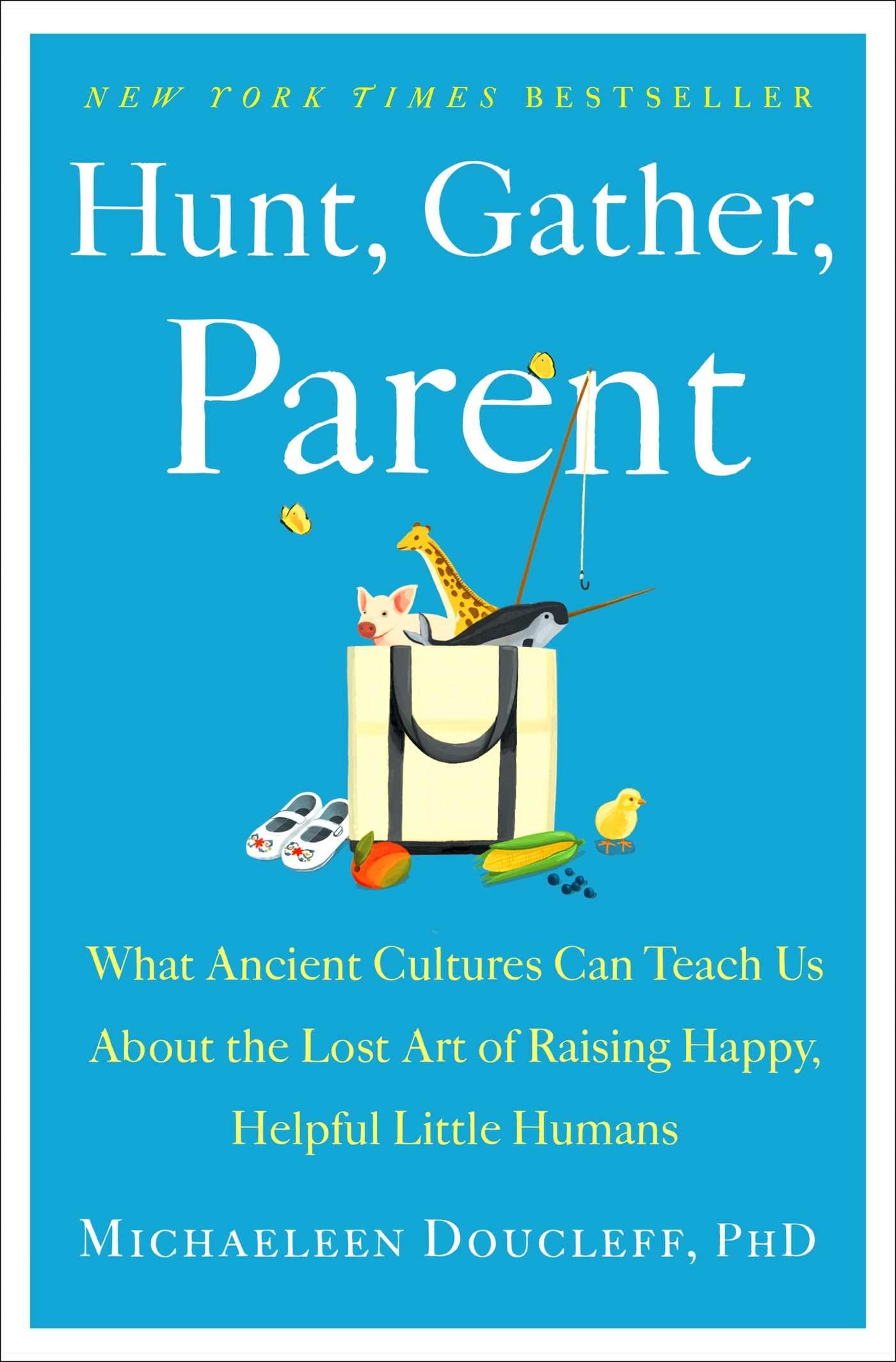
Author: Michaeleen Doucleff
Genre: Parenting / Anthropology / Non-Fiction
Ideal For: Parents who feel exhausted, overwhelmed, or trapped in power struggles—and who are curious about calmer, more collaborative ways to raise capable, confident children without yelling, bribing, or constant negotiation.
A Parenting Book That Changes How You See Children
Hunt, Gather, Parent is one of those rare parenting books that doesn’t just offer techniques—it rewires your perspective. Michaeleen Doucleff doesn’t approach parenting as a problem to be fixed or optimized. Instead, she asks a far more radical question: What if modern parenting itself is the anomaly?
Drawing on anthropology, field research, and her own struggles as a mother, Doucleff explores how Indigenous communities around the world raise children who are cooperative, emotionally resilient, and deeply integrated into family and community life—without time-outs, sticker charts, or endless arguments.
The result is a book that feels both revelatory and grounding. It doesn’t shame parents. It doesn’t promise perfection. It simply shows that there are other ways—and that many of them are gentler, calmer, and far more sustainable.
From Burnout to Curiosity
Doucleff begins the book from a place many parents will recognize: burnout. Her young daughter is defiant, explosive, and resistant to authority. Traditional Western parenting advice—constant praise, negotiation, emotional validation paired with control—only seems to escalate conflict.
Rather than blaming herself or her child, Doucleff does something unusual: she looks outward. As a science journalist with access to anthropologists and researchers, she begins investigating how humans have raised children for most of our history.
What she discovers is quietly revolutionary. Across vastly different cultures—the Maya in Mexico, Inuit families in the Arctic, Hadzabe hunter-gatherers in Tanzania—children are not treated as fragile projects. They are treated as capable contributors.
This shift in mindset becomes the backbone of the book.
The Core Philosophy: Children as Capable Humans
At the heart of Hunt, Gather, Parent is a simple but profound idea: children want to help, belong, and contribute—when we let them.
In many Western households, children are managed, entertained, praised, corrected, and scheduled. Adults do the “real work,” while kids are shuffled between activities. Doucleff contrasts this with cultures where children are naturally folded into daily life—cooking, cleaning, caring for siblings, working alongside adults.
These children aren’t forced to help. They’re invited. And because they feel genuinely useful, cooperation becomes natural rather than coerced.
This reframe alone is transformative. It shifts parenting away from control and toward partnership.
The Three Pillars: Hunt, Gather, Parent
Doucleff structures the book around three broad parenting approaches inspired by different cultures:
Hunt emphasises autonomy and calm leadership, drawing from Inuit parenting practices that prioritize emotional regulation over punishment. Adults model calm behaviour, even during meltdowns, teaching children self-control through example rather than discipline.
Gather focuses on collaboration and inclusion, inspired by Maya communities where children learn by observing and participating, not by being commanded or corrected constantly.
Parent weaves these ideas together, encouraging parents to act as confident guides rather than managers—setting expectations quietly, trusting children’s abilities, and stepping back when possible.
What makes this framework effective is that it’s not rigid. Doucleff doesn’t suggest copying any culture wholesale. Instead, she offers principles that can be adapted to modern life.
Discipline Without Drama
One of the book’s most compelling sections addresses discipline—or rather, the lack of it in the way we typically understand.
In Inuit communities, for example, adults rarely raise their voices. Yelling is seen as a loss of control, not authority. Children learn emotional regulation by watching adults remain calm, even in moments of danger or defiance.
Rather than punishing misbehaviour, adults tell stories, ask reflective questions, or simply wait. The assumption is that children are learning, not misbehaving.
This approach can feel counterintuitive to parents used to immediate consequences. But Doucleff explains the science behind it clearly, showing how calm modeling actually builds long-term self-regulation far more effectively than fear-based discipline.
Praise, Reconsidered
Another quietly radical idea in Hunt, Gather, Parent is its critique of excessive praise.
In many Western parenting philosophies, praise is considered essential for self-esteem. Doucleff challenges this assumption, showing how constant praise can actually undermine intrinsic motivation and create dependency on adult approval.
In the cultures she studies, adults rarely gush over children’s achievements. Instead, they offer neutral acknowledgment or gratitude. The message is: You are part of this group. Your contribution matters.
This doesn’t make children feel unseen—it makes them feel trusted.
For many parents, this section alone is eye-opening. It explains why praise sometimes backfires, leading to performance anxiety or resistance, rather than confidence.
Parenting as Leadership, Not Negotiation
Perhaps the most powerful takeaway from the book is the idea that children feel safest when adults lead calmly and confidently.
Doucleff notes that in many non-Western cultures, adults don’t negotiate every decision with children. They set expectations clearly and matter-of-factly. There is no anger, no pleading, no power struggle.
This isn’t authoritarianism—it’s quiet authority. And children respond to it with surprising ease.
For parents stuck in endless debates over bedtime, screen time, or chores, this shift can be life-changing. The book shows that leadership doesn’t require harshness—just clarity and consistency.
The Writing: Accessible, Curious, and Humane
One of the reasons Hunt, Gather, Parent resonates so strongly is Doucleff’s voice. She writes not as an expert lecturing from above, but as a parent learning alongside the reader.
She is honest about her mistakes, her skepticism, and the moments when these ideas felt uncomfortable or impractical. This humility makes the book deeply readable and trustworthy.
Scientific research and anthropology are woven seamlessly into narrative, never overwhelming or dry. You come away feeling informed, not instructed.
Practical Without Being Prescriptive
Despite its anthropological scope, this is a remarkably practical book.
Doucleff offers concrete suggestions—inviting children to help without praise, narrating tasks calmly, stepping back during conflicts—but she never insists on rigid rules. The emphasis is always on experimentation, observation, and trust.
This flexibility is one of the book’s greatest strengths. Parents aren’t asked to abandon their values or lifestyles. They’re asked to question assumptions and try something different.
Why This Book Feels So Timely
Modern parenting culture is saturated with anxiety. Parents are told they must stimulate, validate, protect, and optimise every moment of their child’s life. The result is exhaustion—for both adults and children.
Hunt, Gather, Parent arrives as a quiet antidote to that pressure. It suggests that children don’t need constant management. They need belonging, responsibility, and calm leadership.
In an era of burnout, this message feels not just refreshing, but necessary.
Where Some Readers May Struggle
It’s worth noting that some readers may find parts of the book challenging. Letting go of praise, stepping back from intervention, or trusting children’s competence can feel risky—especially in fast-paced, safety-conscious environments.
Additionally, while Doucleff is careful not to romanticize Indigenous cultures, some readers may wish for deeper exploration of how these practices translate into modern urban life.
That said, these tensions are acknowledged within the book itself. Doucleff invites questioning, not blind adoption.
Why This Is a Five-Star Parenting Book
Hunt, Gather, Parent earns five stars because it offers something rare in the parenting genre: relief.
It doesn’t add more to your to-do list. It takes things away—guilt, micromanagement, constant correction—and replaces them with trust.
It respects children as capable humans.
It respects parents as learners, not failures.
And it respects the idea that families thrive not through control, but through connection and contribution.
Final Thoughts
This is not a book about becoming a perfect parent. It’s a book about becoming a calmer one.
Hunt, Gather, Parent gently dismantles the myth that parenting must be exhausting to be effective. It shows that cooperation doesn’t come from rewards or punishments, but from inclusion, modeling, and mutual respect.
You may not adopt every idea in this book—and you don’t need to. Even small shifts inspired by its philosophy can radically change the emotional climate of a household.
This is a parenting book you don’t just read—you feel it working, slowly, quietly, over time.