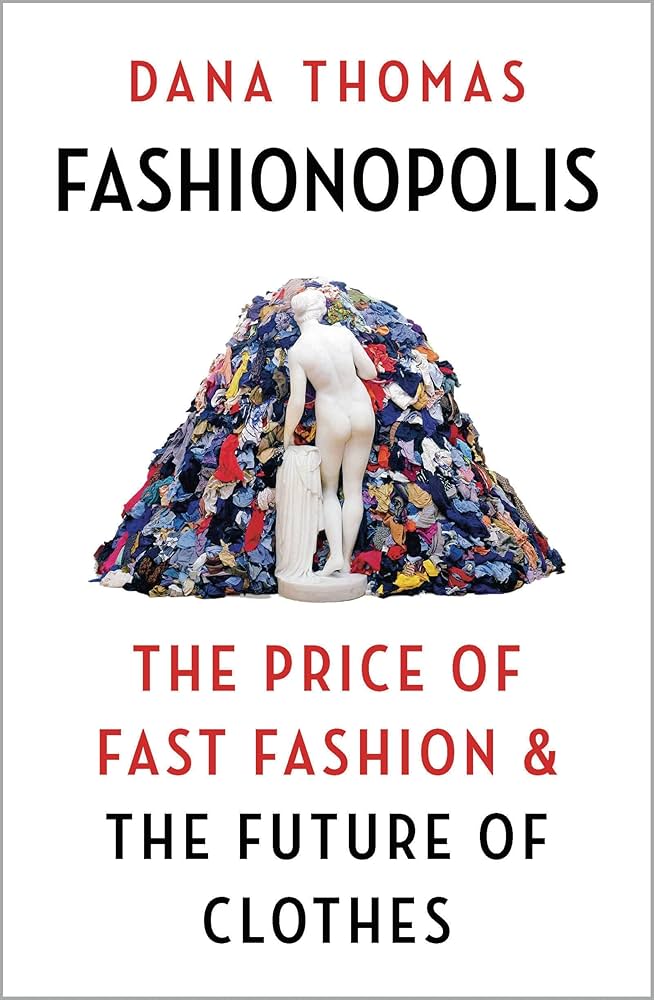
Author: Dana Thomas
Genre: Non-Fiction / Fashion / Sustainability / Cultural Critique
Introduction
Fashionopolis is one of those rare books that permanently alters how you see the world. After reading it, you will never look at a $5 T-shirt, a seasonal trend, or a Zara window display the same way again. Dana Thomas doesn’t just critique fast fashion — she dismantles it, thread by thread, while simultaneously offering something far more valuable than outrage: possibility.
This is not a finger-wagging manifesto or a guilt-laden sustainability sermon. It is an investigative, global, deeply researched exploration of how fashion became disposable — and how it might still save itself.
The Core Question: How Did Fashion Get So Broken?
Thomas begins with a deceptively simple observation: clothing has never been cheaper, faster, or more abundant — yet it has never been more destructive. The modern fashion industry, she argues, is built on a model of overproduction, environmental harm, and human exploitation that is fundamentally unsustainable.
What makes Fashionopolis compelling is that Thomas refuses to stay abstract. She traces the system from the ground up — cotton fields, dye houses, factories, shipping routes — and then outward, into boardrooms, runways, tech labs, and policy circles. The result is a panoramic view of fashion as an industrial machine, not a glamorous fantasy.
You quickly realise this isn’t just a book about clothes. It’s about capitalism, speed, labour, consumption, and our collective appetite for “newness.”
Dana Thomas as Guide: Sharp, Informed, Unsentimental
Dana Thomas is an ideal guide through this landscape. As a veteran fashion journalist, she knows the industry intimately — not as an outsider critic, but as someone who has reported on luxury houses, attended runway shows, and interviewed designers for decades.
Her voice is authoritative without being preachy, critical without being cynical. She doesn’t romanticise “the old days” of fashion, nor does she villainise every brand or consumer. Instead, she brings receipts — statistics, interviews, site visits, and firsthand reporting — and lets the system reveal itself.
What stands out most is her refusal to simplify. Fast fashion isn’t evil because it’s cheap; it’s dangerous because of scale. Luxury isn’t virtuous by default; it can be just as extractive. Sustainability isn’t a vibe; it’s a supply-chain problem.
Fast Fashion: Speed as the Original Sin
One of the book’s most powerful sections dissects the rise of fast fashion and the cult of speed. Thomas explains how companies like Zara, H&M, and later ultra-fast platforms rewired consumer expectations — training us to see clothing as temporary, replaceable, almost disposable.
Trends now move not seasonally but weekly. Clothing is designed to fail — in fabric quality, construction, and relevance — ensuring constant turnover. The environmental cost is staggering: water pollution from dyes, microplastics from synthetics, mountains of textile waste shipped to the Global South.
What’s particularly chilling is how normal this system has become. Thomas shows how speed eroded not only garment quality, but also the dignity of labour — compressing production timelines to the point where worker safety becomes negotiable.
The Human Cost: Labour, Lives, and Invisibility
Fashionopolis is at its most devastating when it centres the people behind our clothes. Thomas travels to manufacturing hubs across Asia and beyond, documenting working conditions that remain largely invisible to Western consumers.
She does not sensationalise suffering. Instead, she contextualises it — explaining how razor-thin margins, relentless deadlines, and buyer pressure create environments where exploitation is not accidental but structural.
What makes these chapters so effective is Thomas’s insistence that this is not a distant problem. Every “cheap” garment carries the cost somewhere else — in wages suppressed, safety ignored, bodies exhausted.
Yet she also highlights progress: factories experimenting with automation to reduce dangerous tasks, worker-owned cooperatives, brands choosing to pay living wages even when it costs more. The book refuses despair — and that restraint gives it credibility.
Greenwashing: When Sustainability Becomes Marketing
One of Fashionopolis’ sharpest critiques is aimed at greenwashing — the fashion industry’s favourite survival tactic. Thomas dismantles buzzwords like “conscious,” “eco-friendly,” and “sustainable collections,” showing how easily they can obscure business-as-usual practices.
A single organic cotton line does not cancel out overproduction. Recycling programs do not justify making billions of garments annually. Carbon offsets do not undo toxic dye runoff.
This section feels especially urgent because it equips readers with discernment. Thomas teaches you how to spot substance versus performance — which changes feel structural, and which are cosmetic.
The Hopeful Turn: Innovation, Craft, and Systems Thinking
Where Fashionopolis truly shines — and why it earns five stars — is in its second half. Rather than ending in critique, Thomas pivots toward solutions. And not vague ones, but concrete, fascinating, sometimes radical alternatives.
She explores:
• Designers embracing circularity — garments designed for disassembly and reuse
• Scientists developing lab-grown leather and biodegradable fibres
• Factories using closed-loop water systems
• Cities investing in local manufacturing hubs
• Brands slowing production and rejecting trend cycles
• Artisans reviving craft as a sustainable economic model
These chapters are electric. You can feel Thomas’s genuine excitement as she documents innovation happening right now — not hypothetically, but in labs, workshops, and factories.
Importantly, she doesn’t claim these solutions are perfect. Some are expensive. Some are still experimental. But collectively, they prove that fashion does not have to function the way it currently does.
Luxury Reconsidered: Craft Over Volume
One of the book’s most nuanced arguments concerns luxury fashion. Thomas is critical of how even high-end brands have adopted fast-fashion logic — accelerating collections, expanding output, chasing novelty.
Yet she also defends a different vision of luxury: craftsmanship, durability, cultural value, and longevity. When clothing is designed to last decades, repaired rather than replaced, and produced with respect for material and maker, it becomes inherently more sustainable.
This reframing is powerful. It suggests that the future of fashion may not be cheaper or trendier — but slower, rarer, and more intentional.
The Consumer Question: What Is Our Role?
Thomas never lets the industry off the hook — but she also doesn’t absolve consumers entirely. She asks uncomfortable questions about desire, boredom, and identity.
Why do we crave constant novelty? Why do we equate self-expression with consumption? Why is owning less so threatening?
Rather than demanding perfection, she advocates consciousness. Buying fewer items. Supporting better brands. Repairing what we own. Treating clothing as something with value, not filler for emotional gaps.
This approach feels humane and realistic — a guide for participation, not purity.
Why Fashionopolis Works So Well
• Depth without overwhelm – The research is extensive but never dry
• Global perspective – Fashion as a planetary system, not a Western trend
• Balance – Critique and hope in equal measure
• Authority – Thomas knows this industry inside out
• Relevance – This book feels more urgent every year
It is both educational and galvanising — the kind of nonfiction that sparks conversations, changes habits, and lingers in your thinking long after the final page.
What Makes It a Five-Star Book
Fashionopolis earns five stars because it refuses easy answers. It respects the reader’s intelligence. It challenges without shaming. And most importantly, it proves that fashion — often dismissed as frivolous — is one of the most revealing lenses through which to examine modern life.
This book is about what we value, how we produce, who pays the price, and whether beauty can exist without destruction.
It is not anti-fashion. It is pro-future.
Final Thoughts: After Fashionopolis, There Is No Unknowing
Reading Fashionopolis feels like crossing a line. Once you understand how deeply fashion intersects with climate, labour, technology, and ethics, you can’t unknow it.
But rather than leaving you paralysed, the book leaves you informed, empowered, and cautiously optimistic. Dana Thomas doesn’t promise salvation — she shows possibility.
If you care about what you wear, where it comes from, or what kind of world it shapes, this book is essential.