Author: Michelle Zauner
Genre: Memoir / Food Writing / Grief & Identity
Ideal For: Readers drawn to emotionally honest memoirs, stories about mother–daughter relationships, and books where food becomes a language for love, loss, and cultural inheritance.
Introduction
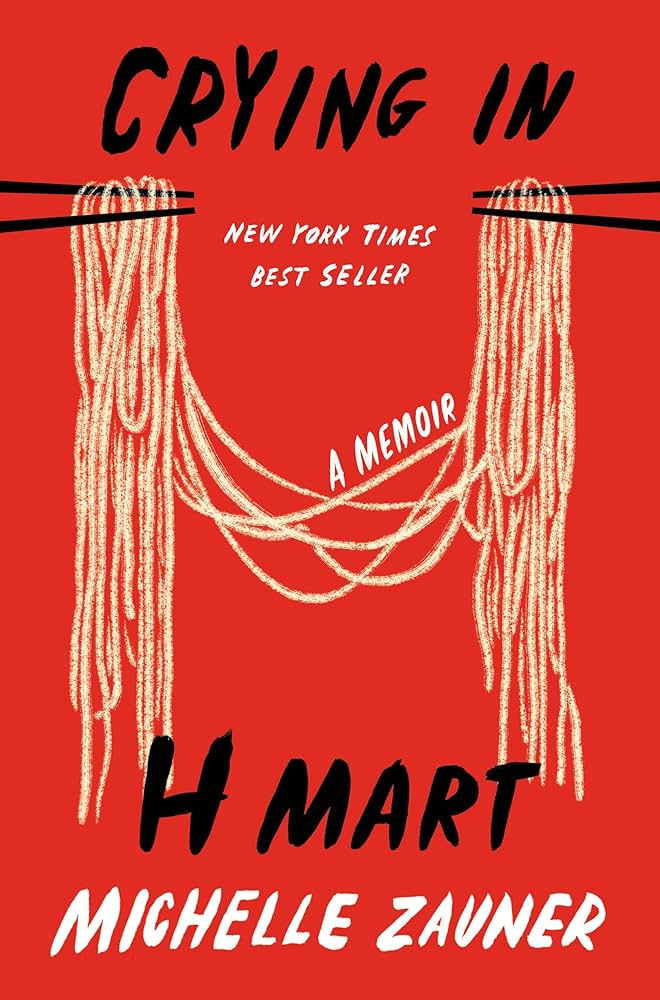
Crying in H Mart is a memoir that feels intimate from its very first sentence, as though the author has leaned across the table and started speaking before you’ve fully sat down. Michelle Zauner writes about grief, but not in abstract terms. She writes about it in grocery aisles, in kitchens heavy with steam and memory, in the silence left behind after a mother’s voice disappears. This is not a book about dramatic revelations or tidy healing arcs. It is about the long, uneven work of mourning—and how identity can unravel and reassemble itself through food, language, and love.
At its core, this is a story about losing a mother. But it is also a story about becoming Korean when the person who tethered you most closely to that heritage is gone. Zauner’s mother, Chongmi, was fierce, demanding, affectionate in her own exacting way, and deeply rooted in Korean culture. When cancer takes her life, Zauner finds herself unmoored—not only emotionally, but culturally. What remains is hunger: for connection, for memory, for the comfort of dishes that once appeared effortlessly on the family table.
Grief Told Through Taste, Smell, and Ritual
One of the book’s greatest achievements is how it renders grief physical. Zauner does not describe sorrow as a vague emotional fog; she gives it texture. Grief tastes like seaweed soup eaten alone. It smells like garlic and sesame oil clinging to clothes. It sounds like the absence of a mother correcting your pronunciation or critiquing your chopping technique.
Food in this memoir is never decorative. It is survival. It is inheritance. It is the last remaining thread connecting Zauner to her mother when conversation is no longer possible. As she shops at H Mart—a Korean grocery store chain that becomes both sanctuary and site of emotional ambush—she encounters ingredients that trigger memories so powerful they collapse time. A packet of dried anchovies can undo an entire afternoon. A tub of doenjang can return her, briefly, to childhood kitchens and arguments and laughter.
Zauner understands something profound: that cooking is often how love persists after death. Recipes become messages passed forward. Dishes are memory made edible. In recreating her mother’s food, she is not merely honoring the past—she is actively stitching it into her present.
A Mother–Daughter Relationship Drawn Without Sentimentality
What makes Crying in H Mart especially powerful is its refusal to idealise the mother–daughter bond. Zauner writes honestly about conflict, resentment, and emotional distance. Her mother could be controlling, critical, and difficult to please. Their relationship was not always gentle. There were arguments about weight, expectations, and cultural difference. There were moments of deep misunderstanding.
And yet, love pulses through every page—not as something soft and easy, but as something fierce, complicated, and enduring. The memoir understands that grief is often sharpened by unresolved tension. Zauner doesn’t mourn a perfect mother; she mourns a real one. This honesty gives the book its emotional credibility. It allows readers to recognise their own complicated relationships reflected back at them without judgment.
As her mother’s illness progresses, the relationship shifts. Old roles collapse. Care replaces authority. Vulnerability replaces control. These passages are written with restraint and grace, never tipping into melodrama. Zauner trusts the reader to feel the weight without being told how heavy it is.
Cultural Identity After Loss
Interwoven with grief is a deep exploration of what it means to inherit a culture unevenly. As a Korean American raised largely in the United States, Zauner always felt partially inside and partially outside her mother’s world. Her mother was the primary conduit to Korean language, customs, and food. When that conduit disappears, Zauner fears losing not just a parent, but an entire cultural lineage.
This anxiety—of becoming disconnected from one’s heritage—is one that many diaspora readers will recognise immediately. Zauner articulates it with precision: the fear that cultural identity can evaporate if not actively practiced, that it requires effort once the effortless bridge of a parent is gone.
Cooking becomes her way back. Not as nostalgia, but as reclamation. Each dish is an act of learning, of choosing to belong. The memoir treats culture not as something static you either possess or lose, but as something alive that must be tended. In this sense, Crying in H Mart is not only a book about mourning, but about rebuilding identity on new terms.
Prose That Is Quiet, Clear, and Devastating
Zauner’s writing style is deceptively simple. Her sentences are clean, unadorned, and emotionally precise. She does not rely on lyrical excess or metaphor-heavy prose. Instead, she allows scenes to unfold with clarity and restraint, trusting that the emotional impact will come from specificity.
This approach makes the grief feel intimate rather than performative. You never feel as though you are being guided toward an emotion; you discover it yourself, often mid-sentence, often unexpectedly. A description of cooking rice can land with the force of a confession. A memory of an argument can feel like a bruise touched too soon.
The memoir’s pacing mirrors the experience of grief itself. There are stretches of relative calm, followed by sudden emotional ambushes. Time expands and contracts. Some memories linger; others flash by with brutal efficiency. This structural rhythm gives the book an authenticity that is difficult to manufacture.
Food Writing That Transcends the Genre
While Crying in H Mart is frequently praised for its food writing, what makes it exceptional is that the food is never an end in itself. This is not a collection of lovingly rendered recipes or a tour of Korean cuisine for its own sake. Food functions as narrative device, emotional anchor, and cultural archive.
Zauner writes about Korean dishes with reverence, but also with the casual intimacy of someone for whom these foods are deeply personal. There is no performative explanation for an imagined outsider audience. Instead, she invites the reader into her relationship with the food—how it tastes when eaten in grief, how it feels to prepare it incorrectly and remember being corrected.
Food, in this memoir, is not comfort in the conventional sense. It does not make grief disappear. It makes it bearable. It gives it form. It allows grief to be shared, even when it must be eaten alone.
The Intersection of Art, Survival, and Selfhood
Though the memoir is primarily about grief and family, it also traces Zauner’s journey as an artist. Music appears not as a separate thread, but as another means of survival. Creativity becomes a way to metabolise loss, to transform pain into something communicable.
What’s striking is how unsentimental Zauner is about this process. Art does not save her in any dramatic way. It does not fix grief. It coexists with it. The book resists the temptation to frame creativity as redemption. Instead, it presents it as another tool—imperfect, necessary, human.
This refusal to offer easy transformation is part of what makes the memoir so trustworthy. Healing, here, is not linear. It does not culminate in closure. It settles into something quieter: the ability to carry loss without being consumed by it.
Why This Book Resonates So Widely
The enduring power of Crying in H Mart lies in its universality. You do not need to share Zauner’s cultural background, her relationship with food, or her specific loss to feel seen by this book. It speaks to anyone who has lost someone who once anchored them to a version of themselves.
It understands that grief is not just about missing a person; it is about missing who you were when they were alive. It is about losing the future you assumed would exist. It is about navigating a world that continues unchanged while your internal landscape has been permanently altered.
Zauner captures this with remarkable clarity. Her memoir offers companionship rather than instruction. It does not tell readers how to grieve. It sits with them while they do.
Why It Earns Five Stars
Crying in H Mart earns its five-star rating not because it is emotionally overwhelming, but because it is emotionally precise. It is a book that understands restraint, that trusts the intelligence and sensitivity of its reader, and that refuses to flatten grief into something inspirational or tidy.
It succeeds as a memoir, as food writing, as a cultural exploration, and as an intimate portrait of a mother–daughter relationship. Few books manage to balance so many elements without diluting any of them. Zauner’s voice remains steady throughout, grounded in honesty and specificity.
Most importantly, it is a book that lingers. Long after you finish reading, you may find yourself thinking about your own inheritance—culinary, cultural, emotional—and how it continues to shape you, even in absence.
Final Verdict
Crying in H Mart is a rare memoir that feels both deeply personal and quietly expansive. Michelle Zauner has written a book that honours grief without aestheticising it, that explores cultural identity without simplifying it, and that treats food as what it so often is in real life: memory made tangible.
This is not a book you rush through. It is one you live with for a while, returning to passages, sitting with its silences, letting it remind you that love does not end when language does. Sometimes, it simply changes form—into a dish, a ritual, a grocery store aisle where tears come without warning.