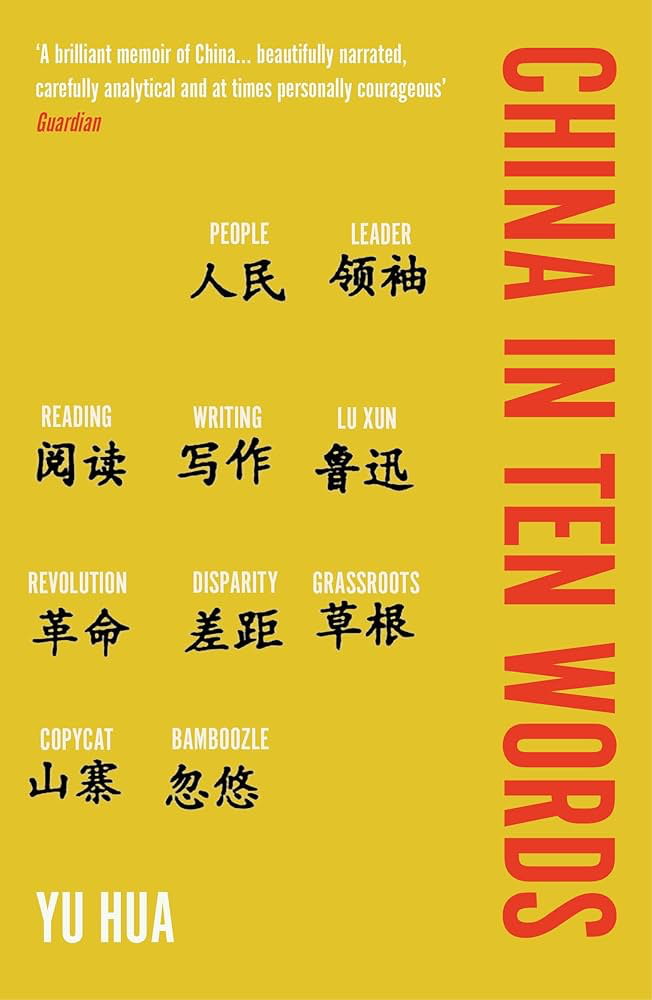
Author: Yu Hua
Genre: Non-fiction / Essay / Modern China Memoir
Ideal For: Readers who want to understand China not through statistics but through stories — people who prefer fragments of lived reality over polished history. If you’re drawn to intimate, unvarnished portraits of a country in transformation, this book is a masterclass in compression and truth.
Ten Words, Ten Windows Into a Country Becoming Itself
Yu Hua’s China in Ten Words is not an academic text or a political manifesto. It is a collection of ten essays, each anchored by a single Chinese word — “People,” “Leader,” “Revolution,” “Disparity,” “Copycat,” “Bamboozle,” “Grassroots,” “Writing,” “Lu Xun,” and “Tomorrow.” Each word becomes a doorway into something larger: a memory, a contradiction, a history that refuses to settle.
The structure is deceptively simple. Yu Hua writes like someone paging through a personal dictionary of the nation’s psyche, tracing what each word once meant, what it means now, and what it costs to say it out loud. What results is a portrait of China’s last fifty years — from the Cultural Revolution to hyper-capitalist modernity — told with irony, affection, grief, and a storyteller’s timing.
Yu Hua’s Voice: Wry, Unflinching, and Human
Yu Hua is best known for his novels To Live and Chronicle of a Blood Merchant, but here he removes the veil of fiction. The tone is conversational yet electric: he writes as someone who has seen the machinery of history grind through people he knows, and still finds humour in its absurdities. His language is taut, his anecdotes sharp. He can turn from tragedy to comedy in a single line.
There’s no lecturing tone. Instead, Yu Hua trusts irony. When he recalls growing up during the Cultural Revolution, he describes children who memorised Mao’s slogans before learning arithmetic, or how he and his classmates competed in denouncing teachers — both horrifying and darkly comic. The style is closer to oral storytelling: precise, rhythmic, aware that history is both deadly serious and slightly ridiculous.
What makes the prose magnetic is Yu Hua’s honesty. He does not idealise the past or romanticise the present. He writes as a participant and witness, aware of both guilt and complicity. That balance — neither outsider’s critique nor nationalist defence — gives the book its moral authority.
Ten Words That Become a Mirror
Each chapter could stand alone, but together they form a map of a people’s inner life.
“People.” Once sacred, now hollowed out. Yu Hua tracks how renmin (the people) shifted from revolutionary ideal to marketing term — from citizens who shared hardship to consumers who compete for luxury.
“Leader.” The essay recalls the cult of Mao and the transformation of leadership from ideology to celebrity. There’s a sentence that hits like a quiet confession: “For years we called him the sun. Only later did we realise how long a shadow the sun can cast.”
“Revolution.” Here, the author revisits the frenzy of the Cultural Revolution — the mobs, the loyalty dances, the public shaming — not to condemn or justify, but to remember what collective madness feels like.
“Disparity.” Yu Hua travels from impoverished countryside to cities gleaming with glass towers. The word becomes shorthand for inequality — not only of wealth, but of dignity.
“Copycat.” A brilliant, funny chapter about imitation culture: fake Louis Vuitton, pirated DVDs, “Shanzhai” phones. What starts as parody becomes commentary on creativity, survival, and adaptation.
“Bamboozle.” Both personal and political — from street scams to official deception — it’s about how survival often depends on trickery, and how deception becomes its own moral language.
“Grassroots.” Yu Hua celebrates small-town resilience, the resourcefulness of ordinary citizens making do in impossible systems.
“Writing.” A meta-essay. He talks about how censorship, trauma and memory shape his craft. He recalls learning to write after years as a dentist, and how fiction gave him the freedom that public discourse denied.
“Lu Xun.” An homage to the great modernist writer who turned the scalpel of language on his own society. For Yu Hua, Lu Xun is not an icon on a syllabus, but a ghostly teacher — the conscience who asks, “Are you awake yet?”
“Tomorrow.” The last word is not optimism; it’s persistence. It’s about believing in continuity — that amid contradiction and fatigue, the country keeps moving, endlessly rewriting itself.
Each essay reframes what it means to live inside transformation. The book’s brilliance lies in its method: instead of theory, it uses vocabulary; instead of statistics, it uses memory. The effect is intimate, political, and quietly devastating.
What Works Masterfully
Compact structure, vast scope. Ten essays, but within them an entire nation’s emotional history. Yu Hua makes the macro visible through the micro.
Personal storytelling with moral weight. The anecdotes — a childhood prank, a bus conversation, a pirated-goods market — become moral puzzles about survival, complicity, identity.
Humour as resistance. The book never wallows in despair. Yu Hua’s humour — dry, absurd, humane — becomes a survival mechanism. You laugh even as you recognise the pain behind it.
Language that cuts clean. His prose, translated by Allan H. Barr, carries a rhythm both simple and sharp. Sentences end like small verdicts.
Structure that invites reflection. The separation into ten words allows you to pause, breathe, return. Each word changes meaning as you read further; by “Tomorrow,” you’re reading all ten at once.
The Emotional Core: Between Nostalgia & Dissonance
Perhaps the most striking quality of China in Ten Words is its emotional texture. It oscillates between nostalgia and dissonance — longing for simplicity, yet unable to forget the cost of that simplicity. When Yu Hua describes the communal poverty of his youth, there’s affection for the collective spirit, but also a recognition that poverty wasn’t purity; it was confinement.
In later chapters, he observes how the pursuit of wealth replaced ideology. Streets once filled with slogans are now filled with advertisements. The citizens who once sang in unison now buy in isolation. Yet he doesn’t moralise. He simply watches, listens, writes.
His empathy extends even to those who disappoint him: the corrupt official, the opportunistic businessman, the child obsessed with brand-name shoes. Each is part of the same machinery of survival.
A Minor Note (But Honest)
If you come seeking linear history, the book may feel elliptical. There are no footnotes, no chronology to hold onto. Yu Hua drifts between decades. But that’s precisely the point — modern China doesn’t move in straight lines. It leaps, contradicts, doubles back. The style reflects that chaos faithfully.
Why You’ll Remember It
You’ll remember the image of a child writing Mao quotations on the classroom wall with trembling hands. You’ll remember the counterfeit-market humour of Copycat — how imitation can be both theft and creativity. You’ll remember the stillness in Tomorrow, where hope feels like a quiet, stubborn act.
And you’ll likely think about your own ten words — what vocabulary defines your generation? Which words changed meaning without your noticing?
The genius of Yu Hua’s book is that it turns language into archaeology. Each word reveals a stratum of history, showing how societies rewrite themselves not only in policy but in speech.
China in Ten Words is small in form yet immense in reach — a book that uses simplicity to expose complexity. Yu Hua has crafted a mirror made of ten words, each reflecting courage, memory and contradiction. You finish it humbled, not by grandeur, but by clarity: a writer, a country, and the words that made them both.