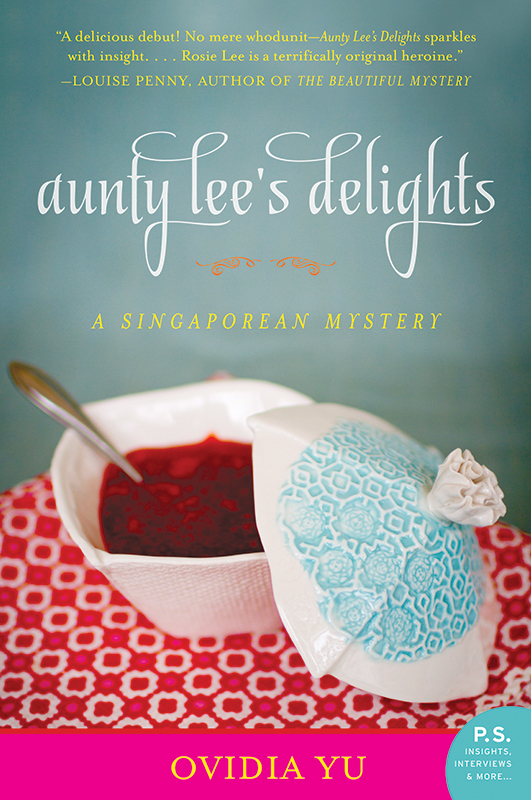
Author: Ovidia Yu
Genre: Cozy Mystery / Singaporean Fiction / Culinary Crime
Ideal For: Readers who adore clever amateur sleuths, delicious food writing, warm humour, and mysteries that reveal as much about community and culture as they do about crime. Perfect for fans of Arsenic & Adobo, Finlay Donovan is Killing It.
Introduction
There are fictional detectives you admire, those you fear, and those you root for — and then there are those you want to sit down and have dinner with. Aunty Lee, the star of Ovidia Yu’s Aunty Lee’s Delights, belongs wholeheartedly to that last category. She is delightful, nosy, warm, meddlesome, and endlessly perceptive, armed with razor-sharp intuition and an encyclopedic knowledge of Singaporean food.
This first installment in the “Aunty Lee” mystery series sets the tone for everything readers will come to love about Yu’s writing: a cozy mystery with cultural depth, lovingly crafted humor, and a heroine who is larger than life yet profoundly human.
Aunty Lee: A Force of Nature (and Nasi Lemak)
Madam Rosie “Aunty” Lee is recently widowed but far from lonely. She channels her energy into running Aunty Lee’s Delights, a Peranakan café famous for its home-cooked dishes and her unstoppable curiosity.
Aunty Lee is the kind of woman who remembers what you ate last, what you should have eaten instead, and who you were flirting with while you were eating it. She is both maternal and mischievous, equipped with formidable social intelligence that allows her to coax secrets out of anyone — from nervous tourists to high-society socialites.
Her café is more than a restaurant; it’s a hub of gossip, comfort, community, and — as it turns out — crime-solving.
The Plot: A Missing Woman, a Mysterious Death, and Aunty Lee on the Case
The novel opens with preparations for a dinner party hosted at Aunty Lee’s café — a gathering of guests who don’t fully know what they’re stepping into. When a body washes ashore on Sentosa and one of the dinner guests is reported missing, Aunty Lee’s instincts start buzzing.
While the police are busy drawing formal boundaries and following protocol, Aunty Lee starts following her own trails:
Who was the missing woman? Why did she disappear?
Why does everyone seem to be lying?
And why is it that people always talk more when they’re well-fed?
It’s a classic cozy-mystery setup, but Ovidia Yu infuses it with so much cultural specificity, humor, and social commentary that it feels wholly fresh. The mystery unfolds at a satisfying pace — not too slow, not too frantic — allowing readers to savor both the clues and the cuisine.
The Writing: Warm Humour Meets Sharp Cultural Insight
Yu’s voice is inviting and observant. She writes with a Singaporean heartbeat — the cadence, humor, and food references feel authentic and full of love for the island’s complexities. You can hear the chatter of hawker stalls, smell the sambal frying, and sense the tension that comes from living in a multicultural, multi-lingual society where rules are both rigid and unspoken.
But beneath the humour lies incisive commentary.
Yu touches on themes like:
• immigration and foreign domestic workers
• class divisions
• the façade of upper-class respectability
• generational conflict
• gender roles in Asian societies
She does this subtly — never lecturing, always storytelling — and the result is mystery fiction with backbone and bite.
Aunty Lee as a Heroine: Why She Works So Well
What sets Aunty Lee apart from other cozy-mystery protagonists?
She’s older.
In a genre dominated by sprightly young detectives or retired busybodies, Aunty Lee is a refreshing portrayal of mature womanhood: empowered, witty, sharp, and not even slightly diminished by age.
She’s food-oriented.
Food is not garnish in this book — it’s world-building. Yu ties recipes to emotions, culture, motives, and relationships. When Aunty Lee feeds someone, she is also reading them.
She’s morally grounded but imperfect.
Aunty Lee loves gossip, meddles in other people’s business, and sometimes leaps before she thinks. But her motivations are always rooted in compassion and justice.
She listens.
Her detective work thrives not on forensic science or dramatic confrontations but on conversation — eavesdropping, chatting, asking seemingly irrelevant questions. Her genius lies in her humanity.
This balance makes her not only a wonderful sleuth but also one of the most endearing amateur detectives in contemporary fiction.
The Supporting Cast: A Richly Drawn Ensemble
Part of what makes the novel shine is its cast:
Nina Balignasay, Aunty Lee’s Filipina helper, is competent, funny, and emotionally layered. She is not a background character but a partner — the Watson to Aunty Lee’s Sherlock — balancing practicality with empathy.
Mark and Selina, Aunty Lee’s stepson and stepdaughter-in-law, embody a new-money Singaporean mentality that Aunty Lee subtly critiques with humour and grace.
Inspector Salim, the weary policeman, learns (slowly) to respect Aunty Lee’s unconventional methods.
The guests at the fateful dinner party — each with secrets, pretensions, and private fears — round out the novel’s snapshot of Singapore’s social layers. The characters feel real, flawed, and reflective of the nation’s multicultural vibrancy.
Atmosphere and Setting: Singapore as a Character
Few mystery novels use setting as effectively as Aunty Lee’s Delights. Singapore is not window dressing — it’s part of the mystery’s fabric.
Ovidia Yu captures:
• the bustle of Chinatown markets
• the rituals of Peranakan cooking
• the gossip networks in cafés and hawker centres
• the polished calm of Sentosa hiding darker currents below
Readers unfamiliar with Singapore will feel transported. Those who know it will recognise its authenticity — the way Yu captures both its efficiency and its messiness, its beauty and its contradictions.
The cultural specificity adds richness without alienating international readers. Instead, it welcomes them — through food, humour, and Aunty Lee’s infectious curiosity.
The Mystery: Comforting Yet Clever
While this isn’t a twist-heavy thriller, the puzzle is well-crafted and surprisingly intricate. Yu seeds clues throughout the narrative, rewarding attentive readers without making the solution too obvious.
The investigation itself is refreshing:
There are no high-speed chases, no forensic labs, no ominous serial killers.
Instead, there is conversation. Observation. Human nature. Food shared at tables where secrets loosen like steam off hot laksa.
The final reveal feels earned, emotionally resonant, and deeply tied to the book’s themes about power, vulnerability, and the cost of maintaining appearances.
Why It’s a Five-Star Read
Aunty Lee’s Delights earns five stars not because it’s a perfect mystery but because it’s a perfect experience.
It delights, comforts, and surprises while giving readers a heroine who is unforgettable in her warmth and intelligence. The writing is crisp, the pacing balanced, and the cultural insight profound without ever feeling heavy-handed.
Most importantly, the book has heart. And heart is what keeps readers returning to a series, to characters, to a fictional world that feels like home.
The Emotional Core: Compassion, Curiosity, and Community
At its heart, Aunty Lee’s Delights is about connection. About the small acts of care that build community — sharing meals, remembering someone’s preferences, listening when others overlook their pain.
Aunty Lee solves mysteries not because she is nosy but because she pays attention.
She notices people.
And in today’s world, that is quietly radical.
Yu argues that justice does not always come from authority — sometimes it comes from kindness, persistence, and the courage to ask uncomfortable questions.
Final Thoughts: Why You Should Read It
If you love mysteries that nourish you as much as they intrigue you, Aunty Lee’s Delights is essential reading. It’s a breath of fresh air in a genre often crowded with darkness — proof that mystery novels can be warm, funny, culturally rich, and deeply human.
By the end, you’ll wish you could walk into Aunty Lee’s café, inhale the scent of sambal and pandan, and sit across from her as she offers you a plate of Peranakan treats and asks — gently but shrewdly — what secrets you’re carrying.
Because you know she’ll figure them out anyway.