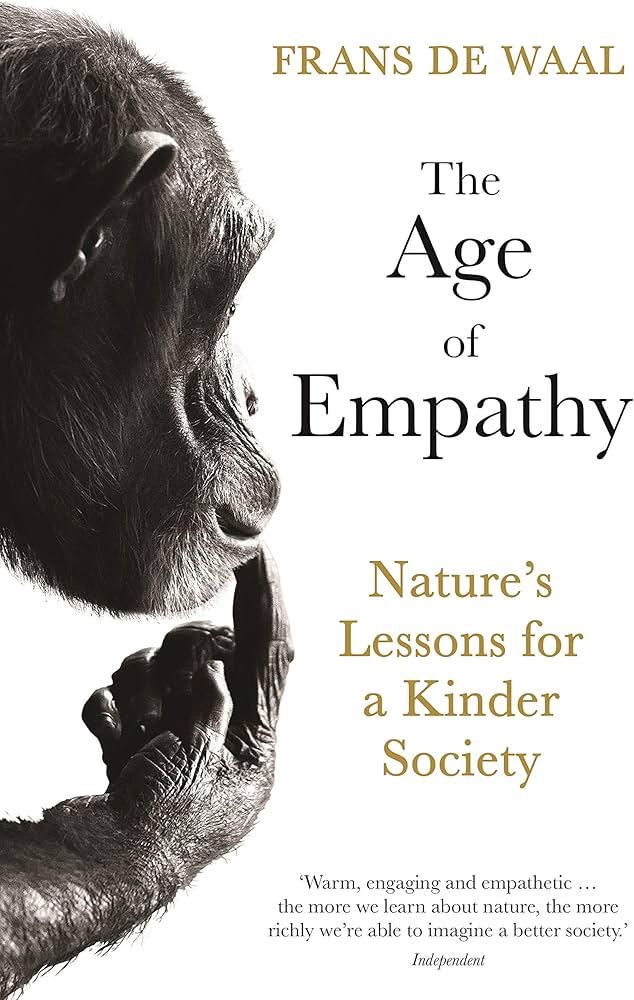
Author: Frans de Waal
Genre: Non-fiction / Psychology / Evolutionary Biology
Ideal For: Readers fascinated by what makes us human — and what connects us to animals. If you love books that blend science, storytelling, and moral inquiry, The Age of Empathy is a powerful, humane, and quietly revolutionary read.
The Premise: Against the Myth of the Ruthless Animal
Frans de Waal begins The Age of Empathy with a challenge: to question the story we’ve been told about nature. For centuries, we’ve inherited a vision of the animal world — and by extension, human society — as defined by competition, selfish genes, and survival of the fittest. But de Waal, one of the world’s leading primatologists, argues that this picture is incomplete.
Empathy, he says, is not an invention of civilisation — it’s an inheritance from evolution. From bonobos consoling the losers of a fight, to elephants helping injured companions, to rats refusing to harm other rats for food, de Waal marshals evidence showing that cooperation and compassion are as deeply embedded in biology as aggression. The book’s central claim is simple but transformative: empathy is not weakness. It’s adaptive, ancient, and essential.
The book unfolds in layers — a scientific inquiry, a moral argument, and a plea for rebalancing how we think about ourselves. Where earlier generations of scientists (and economists) used competition as the guiding metaphor, de Waal urges us to consider empathy as an equally powerful force shaping behaviour, survival, and society.
De Waal’s Voice: Warm, Witty, and Disarmingly Accessible
De Waal writes with the ease of a storyteller and the rigour of a scientist. His tone is patient but never distant, witty without being glib. You sense that he’s been observing primates for decades not just as a researcher but as a kind of chronicler of moral behaviour. His anecdotes sparkle — a chimp named Peony helping an older female climb, a bonobo sharing fruit instead of hoarding it — and each example lands like evidence in a quiet courtroom of empathy.
There’s an elegance in how he balances science and humanity. He doesn’t turn animals into saints, nor humans into villains. Instead, he writes as if saying: “Look closely. You’ll see yourself in them.”
De Waal also manages to puncture clichés with humour. When critics accuse him of anthropomorphism, he flips the term: perhaps, he suggests, we should worry more about anthropodenial — the refusal to see continuity between ourselves and other species. It’s a subtle reversal that captures his charm: scientifically grounded, yet philosophically playful.
Themes That Resonate
Empathy as Evolution, Not Exception.
The heart of the book lies in demonstrating that empathy isn’t a recent moral invention. It’s older than language. Through experiments with apes, dolphins, and elephants, de Waal shows that emotional attunement — the ability to sense and respond to another’s pain — is widespread across species. The impulse to help, console, share, and nurture arises naturally, not as the product of moral reasoning but as instinct.
The False Binary of Competition vs. Cooperation.
De Waal dismantles the notion that evolution rewards only selfishness. He draws from Darwin himself — who noted that sympathy may be humanity’s strongest trait — to show that cooperation often yields the best survival outcomes. A society of constant competition collapses. The myth of the “ruthless animal” is, in fact, a human projection.
Politics, Economics, and the Empathy Deficit.
While the book stays grounded in biology, its implications ripple into society. De Waal critiques economic models that assume selfish rational actors and points to communities — human and animal — that thrive through reciprocity. He doesn’t preach policy, but the subtext is clear: if empathy is natural, systems that ignore it are unnatural.
The Roots of Morality.
Perhaps the most compelling thread is his argument that morality predates religion. He presents morality not as divine command but as social instinct — the structure that allows communities to thrive. The story of a chimpanzee who separates two fighting individuals, acting as a mediator, is as moral as any parable.
Empathy in Crisis.
In a world obsessed with dominance — corporate, political, digital — de Waal’s message feels radical. He suggests that the “age of empathy” isn’t something to come; it’s something to rediscover. Survival in the 21st century, he hints, depends less on asserting power than on reawakening connection.
What Works Brilliantly
Scientific depth, emotional accessibility. De Waal translates ethology into everyday language without dumbing it down. You feel smarter reading him, but also softer. Anecdotes that linger. The stories — of chimpanzees reconciling after fights, of elephants mourning their dead — remain vivid long after you close the book. Clarity of moral vision. He never slips into sentimentality, yet his compassion underpins every page. Balance between rigor and warmth. It’s rare to find a book that can reference neuroscience, Darwin, and daily zoo observations with equal fluency. A quietly urgent argument. The book reads like a counter-manifesto to cynicism. In a culture addicted to outrage and competition, it argues for cooperation without naivety.
A Minor Quibble (But a Meaningful One)
Some readers might crave a sharper focus on practical application. De Waal doesn’t prescribe steps for building empathy into modern institutions — he implies them instead. But that restraint suits the book’s tone. He isn’t writing a self-help manual or political treatise; he’s re-calibrating our lens. His goal is not to legislate empathy, but to prove it’s already there.
Why The Age of Empathy Still Feels Urgent
When you finish the book, you realise it’s not about animals at all — not really. It’s about what kind of story we tell ourselves about being human. De Waal doesn’t promise utopia; he acknowledges cruelty, hierarchy, aggression. But he insists these are not our only defaults. Evolution, he reminds us, built brains that mirror others’ pain, hearts that soften in synchrony.
You’ll remember the image of a bonobo female lifting a fallen comrade, the chimp who shares food with a stranger, the rat who refuses to press a lever when it shocks another rat. You’ll remember, too, de Waal’s quiet conclusion: empathy is not luxury — it’s survival.
And you’ll likely find yourself thinking differently about daily interactions: the colleague who softens an argument, the stranger who holds the door, the instinct to help someone crying on the subway. De Waal’s book is about them too.
He ends not with moral triumph but with invitation — to notice the connective tissue between all living things, to treat empathy as muscle rather than ornament.
The Beauty of De Waal’s Argument
What makes The Age of Empathy extraordinary isn’t just its science; it’s its tone. It’s calm where others shout, nuanced where others simplify. De Waal writes as if he’s trying to heal a misunderstanding — the long-standing belief that to survive we must suppress compassion. He offers data, yes, but also grace.
There’s an elegance in how he reframes Darwinian thought. Where social Darwinists weaponised “survival of the fittest,” de Waal returns to Darwin’s quieter observation — that sympathy, cooperation, and the moral sense are evolution’s greatest achievements. It’s not a sentimental correction but a scientific one.
He’s also unafraid to draw parallels between humans and our primate cousins. When he describes reconciliation rituals among apes — hugging, grooming, peacemaking — you can’t help but recognise your own behaviour. The insight is humbling: empathy isn’t what elevates us above animals; it’s what binds us to them.
A Book That Feels Like an Antidote
In an era saturated with cynicism — where competition is glamorised, empathy politicised — this book feels like a moral reset. It’s not naïve optimism; it’s evidence-based faith in connection.
De Waal doesn’t ask us to become saints. He simply reminds us that kindness, fairness, and cooperation are ancient survival strategies, not modern inventions. The age of empathy isn’t a utopian dream — it’s our evolutionary inheritance.
The power of this idea is immense. Imagine economics grounded in reciprocity, education built on understanding, leadership measured by compassion instead of dominance. De Waal doesn’t paint these futures explicitly, but he hands you the lens to imagine them yourself.
Why It Deserves Five Stars
Because it changes how you see. After reading The Age of Empathy, you won’t look at animals — or humans — in the same way. You’ll see continuity where others see difference. You’ll question the myth that success requires ruthlessness. You’ll find yourself noticing gestures of care as signs of intelligence.
Few books manage to bridge science, philosophy, and everyday life so gracefully. De Waal does it with humour, humility, and hope.
This isn’t just a book about empathy — it’s an act of empathy itself: clear-eyed, open-hearted, and enduringly human.
The Age of Empathy earns its five stars because it transforms a biological truth into moral clarity. Frans de Waal has written something rare — a scientific book that feels like an emotional education. It reminds us that to understand evolution is not to glorify competition, but to rediscover cooperation.
If you’ve ever felt that kindness is weakness, or that empathy belongs only in poetry and not policy, this book will change your mind — and, more importantly, your gaze.