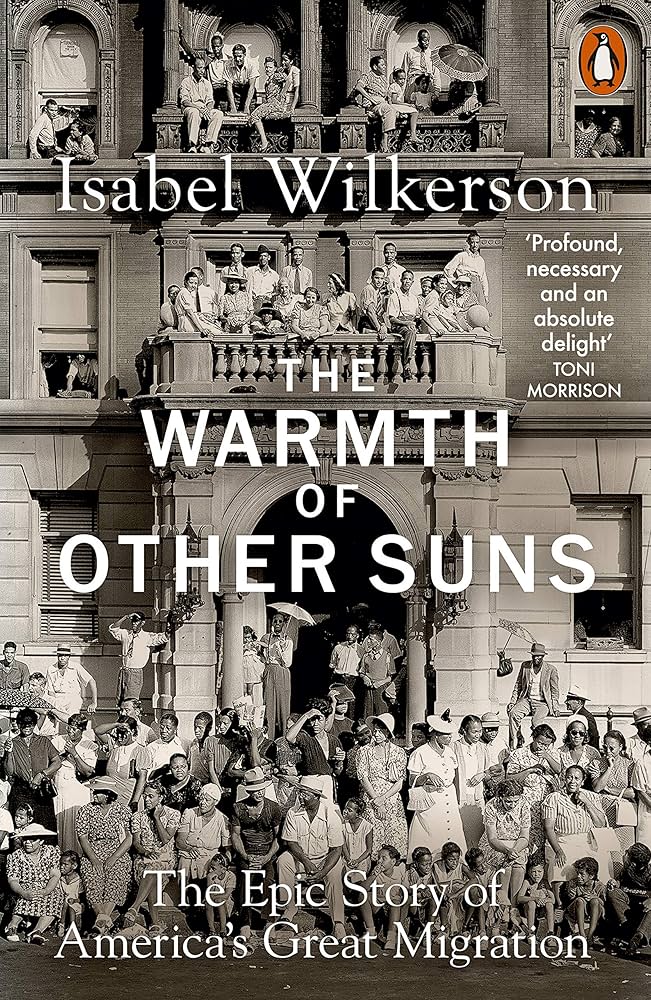
Author: Isabel Wilkerson
Genre: Narrative Non-Fiction / History / Social Justice
Ideal For: Readers who want history to feel alive—those drawn to deeply human stories that illuminate systemic injustice through intimate lives, and anyone seeking to understand how the past continues to shape the present.
Plot Summary (Spoiler-Free)
The Warmth of Other Suns is not merely a book you finish; it is a history you inhabit. Isabel Wilkerson’s monumental work chronicles the Great Migration—the six-decade movement of nearly six million Black Americans who fled the Jim Crow South for the promise of safety, dignity, and opportunity in the North and West. But Wilkerson does something far more ambitious than assemble dates and demographics. She tells this vast national story through the lives of three individuals—Ida Mae Gladney, George Starling, and Robert Foster—rendering history not as abstraction, but as breath, sweat, fear, and hope.
From the opening pages, Wilkerson’s prose is confident and compassionate. She writes with the authority of a seasoned journalist and the empathy of a novelist. The result is a book that reads with the narrative propulsion of fiction and the rigour of scholarship—a rare balance, exquisitely sustained over hundreds of pages.
Three Lives, One Monumental Movement
Wilkerson anchors the epic scale of the Great Migration in three distinct journeys. Ida Mae, a sharecropper’s wife from Mississippi, leaves quietly in the dead of night to escape a life bound by debt and terror. George Starling, a brilliant and restless labor organiser from Florida, is forced to flee when his activism puts a target on his back. Robert Foster, a polished, ambitious physician from Louisiana, drives west toward California, determined to become the kind of man the South would never allow him to be.
Each story unfolds with novelistic care. Wilkerson gives us kitchens and cotton fields, train platforms and cramped apartments, marriages strained by exhaustion and dreams sustained by stubborn hope. These are not symbols or stand-ins; they are fully realised people whose choices feel urgent and terrifying. By following their lives over decades, Wilkerson allows readers to witness not only escape, but arrival—and the complicated realities that followed.
The Courage to Leave, the Cost of Staying
One of the book’s most powerful achievements is its articulation of why people left. Wilkerson refuses to sanitise the brutality of the Jim Crow South. Lynching, arbitrary violence, voter suppression, debt peonage, and daily humiliations form the landscape from which millions fled. Yet she is equally careful to show what was lost: community, land, kinship, the familiar rhythms of home.
Leaving was not romantic. It was dangerous, illegal in some places, and often irreversible. Wilkerson captures the quiet terror of packing one suitcase, the heartbreak of leaving family behind, the shame of sneaking away like a criminal from a place that had never truly been home. The decision to migrate was an act of radical self-preservation—one that required extraordinary bravery.
Arrival Is Not the End of the Story
If the South was a cage, the North was not a promised land. Wilkerson is unflinching in showing how migrants encountered new forms of discrimination—redlining, employment barriers, segregated schools, and racial hostility that shattered illusions of freedom. The warmth of the “other suns” was real, but uneven.
And yet, the migrants persisted. They built communities, reshaped cities, and transformed American culture. Jazz, blues, soul music, literature, politics, and labour movements all bear the imprint of the Great Migration. Wilkerson connects the personal to the structural with extraordinary clarity, showing how individual decisions reshaped the nation’s demographic, cultural, and moral landscape.
Prose That Carries History Gently—and Powerfully
Wilkerson’s writing is luminous without being ornamental. Her sentences are precise, often spare, and always purposeful. She trusts the facts, the voices, the scenes. When she does employ metaphor, it is earned and resonant—migration as tectonic shift, as river, as collective leap of faith.
The book’s structure—interweaving the three narratives with historical context—never feels cumbersome. Wilkerson has an intuitive sense of pacing, knowing when to widen the lens and when to return to the intimacy of a single life. This balance keeps the reader emotionally invested while steadily expanding understanding.
A Journalist’s Rigour, a Novelist’s Heart
What distinguishes The Warmth of Other Suns from many historical works is its ethical clarity. Wilkerson does not posture or sermonise. She lets evidence and lived experience speak. Her research is exhaustive—decades of interviews, archival work, and cross-verification—but it never overwhelms the human story.
She also resists the temptation to flatten her subjects into heroes or victims. Ida Mae is pragmatic and quiet; George is charismatic and flawed; Robert is driven and sometimes brittle. Their imperfections make them real. Their dignity lies not in perfection, but in persistence.
America Reconsidered
This book fundamentally reframes American history. Wilkerson argues—convincingly—that the Great Migration was as consequential as any major war or political revolution. It altered voting blocs, labor markets, urban landscapes, and cultural expression. It laid the groundwork for the Civil Rights Movement and continues to shape debates about inequality, housing, and opportunity.
Reading this book is to see America anew: not as a static nation, but as a place continually remade by people who refused to accept the limits imposed on them. It forces readers to confront uncomfortable truths about freedom—who had it, who didn’t, and what it cost to claim it.
Why It Still Feels Urgent
More than a decade after publication, The Warmth of Other Suns feels astonishingly current. The themes—migration, systemic injustice, the search for dignity—echo in contemporary conversations about race, opportunity, and belonging. Wilkerson’s work provides context without diluting urgency. It reminds us that today’s inequalities are not accidents, but legacies.
The book also offers a quiet, profound lesson about agency. The migrants did not wait for permission. They moved. They changed their circumstances not because the system invited them to, but because survival demanded it. That lesson resonates far beyond the historical moment it documents.
The Emotional Aftermath
Finishing The Warmth of Other Suns leaves a mark. You will think about Ida Mae’s steadiness, George’s fire, Robert’s ambition. You will recognise their descendants in modern cities, in cultural expressions you love, in struggles that persist. The book cultivates empathy without sentimentality and anger without despair.
It is rare to encounter a work that expands both heart and mind so completely. Wilkerson achieves that feat with grace and moral seriousness.
Why This Is a Five-Star Book
Because it does everything great non-fiction should do—and more. It educates without lecturing, moves without manipulating, and illuminates without simplifying. It honors its subjects by telling the truth fully, and it honors readers by trusting their intelligence.
The Warmth of Other Suns is not just essential reading; it is foundational. It belongs on the shelf of any reader who wants to understand America—not as myth, but as lived reality.
Final Verdict
Isabel Wilkerson has written a book that changes how we see the past and, by extension, the present. The Warmth of Other Suns is expansive, intimate, devastating, and hopeful all at once. It is a testament to the power of movement—physical, social, and moral—and to the ordinary people whose courage quietly reshaped a nation.