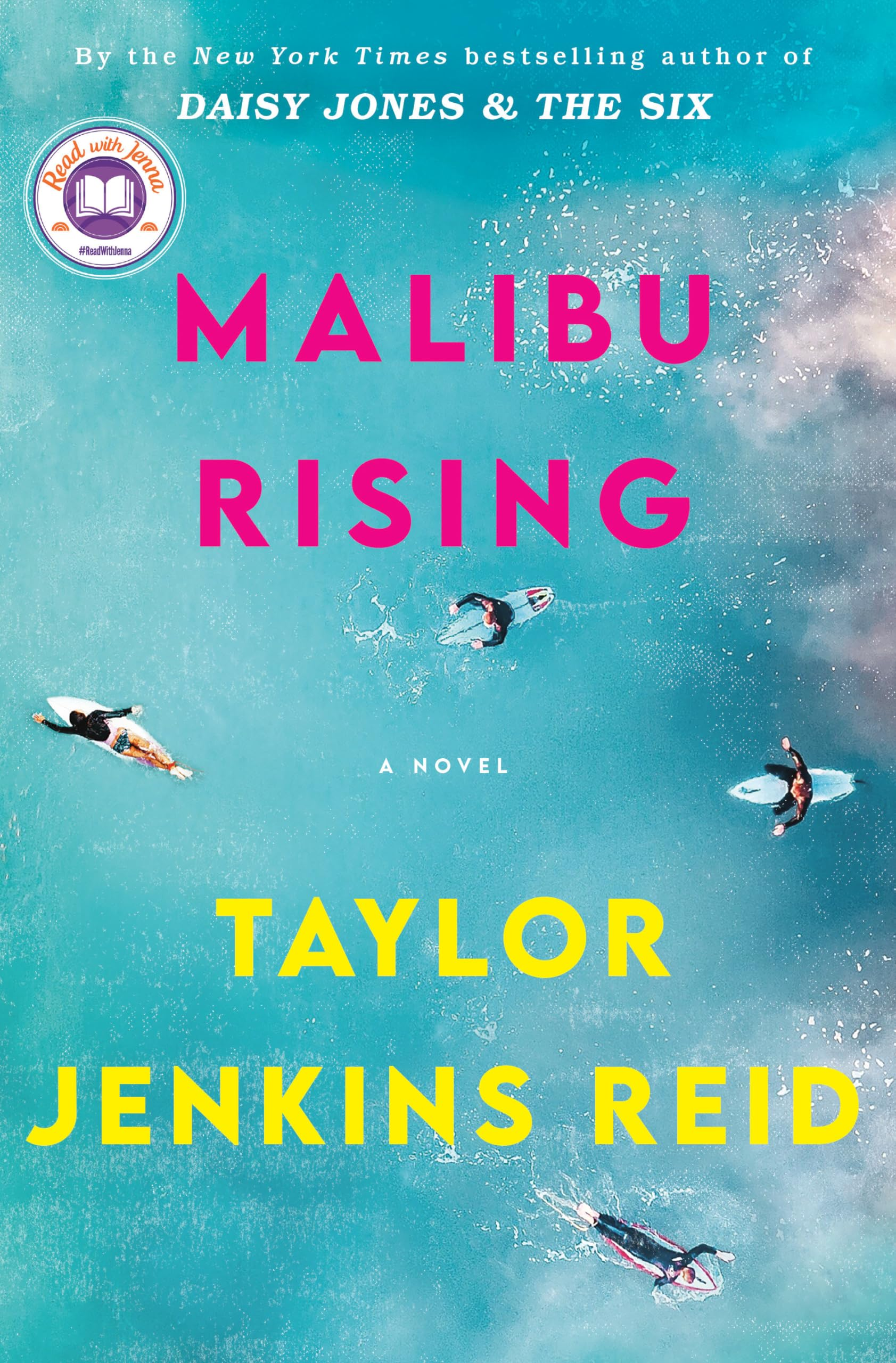
Author: Taylor Jenkins Reid
Genre: Contemporary Fiction / Historical Fiction / Family Saga
Plot Summary (Spoiler-Free)
There are books that unfold slowly across decades, and then there are books like Malibu Rising that compress an entire emotional universe into a single, blazing moment. Taylor Jenkins Reid’s Malibu Rising takes place over the course of one unforgettable summer night in August 1983, but by the time you turn the final page, you feel as though you’ve lived through generations of love, abandonment, ambition, and reckoning.
At its surface, the novel centers around the Riva siblings—Nina, Jay, Hud, and Kit—children of a famous, unreliable singer, Mick Riva, who hosts a legendary end-of-summer party at his Malibu mansion every year. This year’s party, we are told from the outset, will end in flames—literally. The suspense is immediate. We know the house will burn. The only question is why.
But Malibu Rising is not a mystery about arson. It’s a novel about family, about what we inherit from our parents and what we choose to carry forward, about the price of fame and the cost of loving someone who refuses to love you back.
The Riva Siblings: Chosen Family, Earned Love
Taylor Jenkins Reid excels at writing characters who feel fully inhabited, and the Riva siblings are among her most vivid creations. Each one is shaped by the same absence—their father, Mick Riva—but each responds to it differently.
Nina, the eldest, is the emotional anchor of the family. A former professional surfer whose career was cut short, she has spent much of her adult life holding everyone else together—her siblings, her marriage, her reputation. She is responsible, exhausted, and quietly furious. Nina’s arc is one of the most satisfying in the novel: a woman who has always been strong for others finally asking what she wants for herself.
Jay and Hud, professional surfers and best friends, embody different responses to success and loyalty. Jay is disciplined, ambitious, and deeply loyal to Nina, while Hud is charismatic, reckless, and secretly in love with Jay’s wife. Their tension simmers beneath the surface, mirroring the unspoken resentments that define many families.
Kit, the youngest, is only seventeen, still discovering who she is. Her storyline, tender and painful, captures that liminal space between girlhood and adulthood, where freedom feels thrilling and terrifying at the same time. Kit’s choices are impulsive, but they are also heartbreakingly human.
Together, the Rivas form a family forged not by comfort, but by survival. They are bound together because they had to be.
Mick Riva: A Portrait of Charismatic Absence
One of the novel’s greatest strengths is its portrayal of Mick Riva. He is not a caricature of a bad father; he is far more unsettling than that. Mick is charming, talented, and endlessly self-justifying. He loves his children in the abstract, but never enough to show up for them in the ways that matter.
Through flashbacks that trace Mick’s rise to fame and his many failed relationships, Reid explores how neglect can coexist with affection, how abandonment often arrives wrapped in excuses. Mick’s voice is persuasive. At times, you almost believe him. And that’s the point.
Malibu Rising is deeply interested in how parents shape their children not only through what they give, but through what they withhold. Mick’s absence is the gravitational force around which the Riva siblings orbit.
Structure That Mirrors Memory
The novel’s structure is deceptively simple. It moves between the present—Nina’s annual party—and the past, charting Mick’s career and the Riva children’s upbringing. But what makes this structure so effective is how seamlessly Reid weaves cause and effect.
The flashbacks are not interruptions; they are explanations. Every argument, every silence, every decision at the party is illuminated by something that happened years earlier. The result is a narrative that feels both expansive and tightly controlled.
By the time the party begins to unravel—relationships exposed, secrets spilled, boundaries crossed—you understand exactly how it all came to this. Nothing feels random. Everything feels inevitable.
Malibu as a Living, Breathing Presence
Reid’s Malibu is sun-drenched and intoxicating, but never shallow. The ocean, the heat, the house perched above the cliffs—all of it reinforces the novel’s themes of beauty and impermanence.
Malibu is a place where people come to reinvent themselves, to escape their pasts, to be seen. But it’s also a place where the tides always return, where nothing stays hidden forever. The setting becomes a metaphor for the Rivas’ lives: outwardly glamorous, inwardly unstable.
The party itself is a masterpiece of controlled chaos. Celebrities, athletes, teenagers, journalists, and strangers flood the house, each carrying their own desires and expectations. As the night unfolds, the party transforms from a symbol of success into a crucible where truth can no longer be ignored.
Fame, Gender, and the Cost of Visibility
While Malibu Rising is primarily a family saga, it also offers sharp commentary on fame, especially for women. Nina’s career as a surfer is treated differently from her male counterparts’. Her mistakes are magnified. Her ambition is scrutinized. Her marriage becomes public property.
Reid doesn’t belabour these points, but they are woven into the fabric of the story. Nina’s struggle is not just personal; it’s systemic. Her anger feels earned, not dramatic.
The novel asks a quiet but powerful question: Who gets forgiven for chasing success, and who gets punished for it?
Fire as Reckoning, Not Destruction
From the opening pages, we are told that the house will burn down by morning. In a lesser novel, this would feel like a gimmick. In Malibu Rising, it becomes symbolic and cathartic.
The fire is not an act of violence; it is an act of release. It represents the end of a cycle—of silence, of self-sacrifice, of inherited pain. When the flames finally come, they feel less like tragedy and more like transformation.
Reid understands that sometimes healing doesn’t come from rebuilding what was lost, but from letting it go entirely.
Why Malibu Rising Earns Five Stars
This is a five-star novel because it achieves something rare: it is both compulsively readable and emotionally sophisticated.
Taylor Jenkins Reid writes with confidence and restraint. She trusts her readers to connect the dots, to feel the weight of moments without being told how to feel. Her dialogue is sharp. Her pacing is impeccable. Her characters linger long after the final page.
Malibu Rising is about family, but it’s also about freedom. About choosing what parts of your past you carry forward, and what you leave behind. It’s about the courage it takes to stop being the person everyone expects you to be and start being the person you want to become.
Final Verdict
Malibu Rising is Taylor Jenkins Reid at the height of her powers—a novel that balances spectacle with intimacy, drama with restraint, and nostalgia with clear-eyed honesty. It is glamorous without being shallow, emotional without being manipulative, and deeply satisfying without being neat.
This is the kind of book you finish and immediately want to talk about. A modern family saga that burns bright, leaves its mark, and reminds us that sometimes the most powerful thing you can do is walk away from the fire—and let it take what no longer serves you.