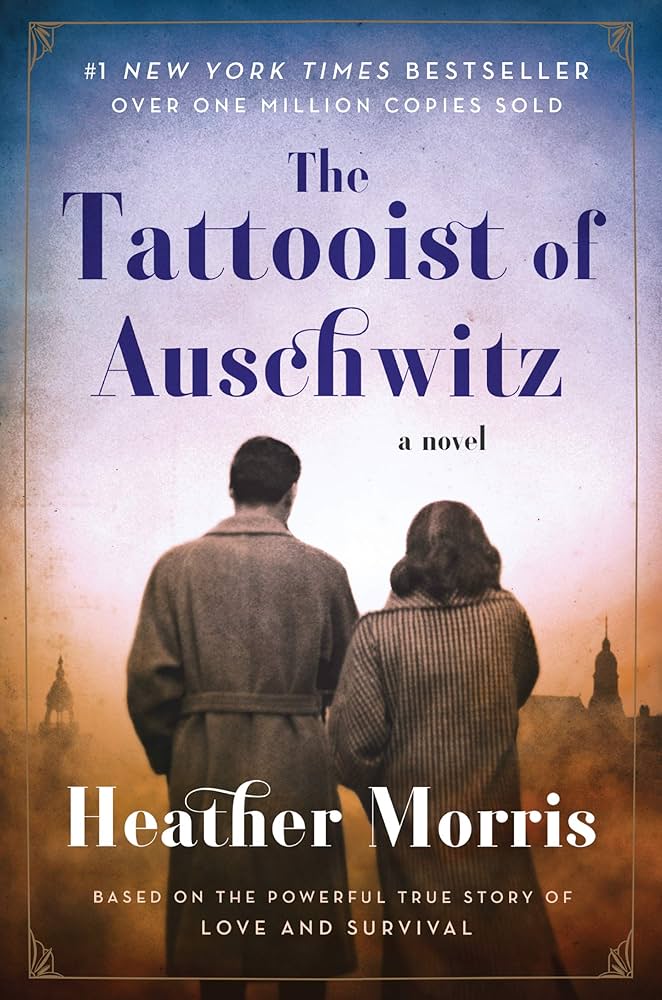
Author: Heather Morris
Genre: Historical Fiction / Holocaust Literature
Ideal For: Readers who believe that stories of love, courage, and humanity matter most when set against history’s darkest moments. This book is for those who want a deeply emotional, accessible entry point into Holocaust fiction — one that centers not only on suffering, but on survival, tenderness, and the stubborn endurance of hope.
Plot Summary (Spoiler-Free)
The Tattooist of Auschwitz tells a story that feels almost impossible to believe — not because it is unrealistic, but because it insists on love where cruelty was absolute. Based on the true story of Lale Sokolov, a Slovak Jew imprisoned at Auschwitz-Birkenau, the novel follows a man whose forced role as the camp’s tattooist becomes both his burden and his unlikely means of survival.
From the moment Lale is tasked with tattooing identification numbers onto fellow prisoners’ arms, the book establishes its central tension: how does one live — and love — in a place designed to erase humanity?
The answer Morris gives is not sentimental or naïve. Instead, she offers a story rooted in quiet resistance: small kindnesses, shared bread, stolen moments of eye contact, and the radical act of caring when everything else is designed to strip that capacity away.
Lale Sokolov: A Survivor, Not a Saint
Lale is not portrayed as a hero in the conventional sense. He is clever, resourceful, sometimes morally conflicted — a man doing what he must to stay alive in a system that offers no good choices. His position grants him marginal privileges, and Morris does not shy away from the discomfort this creates.
This is one of the novel’s greatest strengths. Lale’s survival is not framed as purity or virtue, but as adaptation. He makes deals. He trades. He navigates power dynamics with guards and kapos. He survives — and the book forces us to sit with the reality that survival itself can be morally complicated.
Yet it is precisely this realism that makes Lale’s humanity so compelling. He does not harden. He does not stop seeing people as people. And when he meets Gita Furman, a young woman he tattoos early in his role, the story’s emotional core is born.
Lale and Gita: Love as Defiance
The romance at the heart of The Tattooist of Auschwitz is understated, restrained, and all the more powerful for it. Lale and Gita’s relationship unfolds in fragments — whispered conversations, exchanged glances, moments of risk that could cost them their lives.
This is not a love story driven by grand declarations. It is built on constancy. On showing up. On remembering a face, a name, a number.
Morris writes their bond with tenderness but without illusion. Their love does not shield them from hunger, fear, or loss. Instead, it gives them a reason to endure. In a place designed to reduce people to numbers, their relationship becomes an act of reclamation: I see you. I choose you. You matter.
That sentiment alone makes the book devastating in the best possible way.
The Setting: Auschwitz Without Abstraction
Morris’s prose is direct, unadorned, and deliberately accessible. She does not overwhelm the reader with graphic detail, nor does she soften the horrors of camp life. Instead, she presents Auschwitz through lived moments: roll calls in freezing weather, the smell of smoke, the constant ache of hunger, the arbitrary cruelty of guards.
This approach makes the setting more immediate, not less. By focusing on the daily rhythms of survival, the book conveys the psychological toll of the camp with haunting clarity. You feel the monotony, the fear, the ever-present awareness that life can end without warning.
Crucially, Morris never allows the camp to become mere backdrop. Auschwitz is not just where the story happens — it is the force constantly pressing against every choice, every relationship, every breath.
A Story About Agency in a Place Without It
One of the most quietly powerful themes in The Tattooist of Auschwitz is agency — or the lack of it. Lale’s role gives him small pockets of influence: he can trade jewelry for food, pass along information, help others survive in small ways.
These acts are not framed as heroics. They are framed as what remains when everything else is stripped away. The book repeatedly asks: What does resistance look like when resistance seems impossible?
Sometimes, it looks like sharing bread. Sometimes, it looks like memorising a number so a person doesn’t disappear entirely. Sometimes, it looks like falling in love.
Moral Complexity Without Judgment
Morris deserves credit for not simplifying the ethical landscape of the camp. Lale’s position as tattooist places him in a morally ambiguous space — neither victim nor perpetrator, but something uncomfortable in between.
The novel does not excuse the system that forced these roles into existence, but it also does not condemn individuals for doing what they must to survive. This nuance is essential. It allows the story to remain human rather than ideological.
Readers are trusted to sit with discomfort. To understand that survival in Auschwitz was not about purity — it was about endurance.
The Writing: Simple, Purposeful, Devastating
Morris’s writing style is intentionally straightforward. This is not a lyrical or experimental novel. And that is exactly why it works.
The clarity of the prose mirrors the clarity of the story’s emotional intent. There are no distractions. Every sentence moves the narrative forward. Every chapter ends with a quiet weight that settles in the reader’s chest.
This accessibility also makes the book an important entry point for readers who may be encountering Holocaust literature for the first time. It opens the door without diluting the truth.
Loss, Survival, and the Aftermath
Without revealing spoilers, it’s important to note that The Tattooist of Auschwitz does not end with liberation as a neat resolution. Survival is not portrayed as an ending — it is a beginning filled with its own challenges.
The later sections of the book explore what it means to live after unimaginable trauma. Love does not erase memory. Survival does not mean forgetting. Morris handles this transition with care, showing that healing is not linear, and that the past never truly loosens its grip.
This is where the book becomes not just a historical novel, but a meditation on memory itself — on what it means to carry a life forward when so many were lost.
Why This Book Resonates So Deeply
The Tattooist of Auschwitz resonates because it refuses to let horror be the final word. It insists — gently, persistently — that even in the most inhuman conditions, humanity can survive.
It does not diminish the Holocaust. It does not romanticise suffering. Instead, it focuses on what remains when everything else is taken away: the ability to care.
For many readers, this balance is what makes the book unforgettable. It is devastating, yes — but it is also life-affirming in a way that feels earned.
Addressing the Criticism — And Why It Still Works
Some critics have questioned the novel’s historical precision or its simplicity. But it’s important to understand what The Tattooist of Auschwitz sets out to do.
This is not an academic text. It is a story — one meant to reach as many people as possible, to humanize history through an individual life. Its emotional truth, grounded in real testimony, carries its own weight.
The book’s power lies in its ability to make readers feel history — not as an abstract tragedy, but as a series of lived moments.
Why It Deserves Five Stars
- Emotional impact: Profound and lasting
- Accessibility: Clear, direct, deeply human
- Characterisation: Complex, compassionate, believable
- Themes: Love, survival, moral ambiguity, memory
- Cultural importance: A gateway into Holocaust literature for a wide audience
The Tattooist of Auschwitz earns its five stars because it does something rare: it honours the victims of history by telling a story that is both devastating and humane, tragic and tender.
Final Thoughts
This is not an easy book to read — nor should it be. But it is a necessary one.
The Tattooist of Auschwitz reminds us that history is not made up of numbers or dates alone. It is made up of people. Of names. Of lives. Of love that persisted when the world tried to extinguish it.
You close this book with a deeper sense of responsibility — to remember, to bear witness, and to recognise the quiet heroism of survival.
It is a story that stays with you. Not because it shocks, but because it remembers.