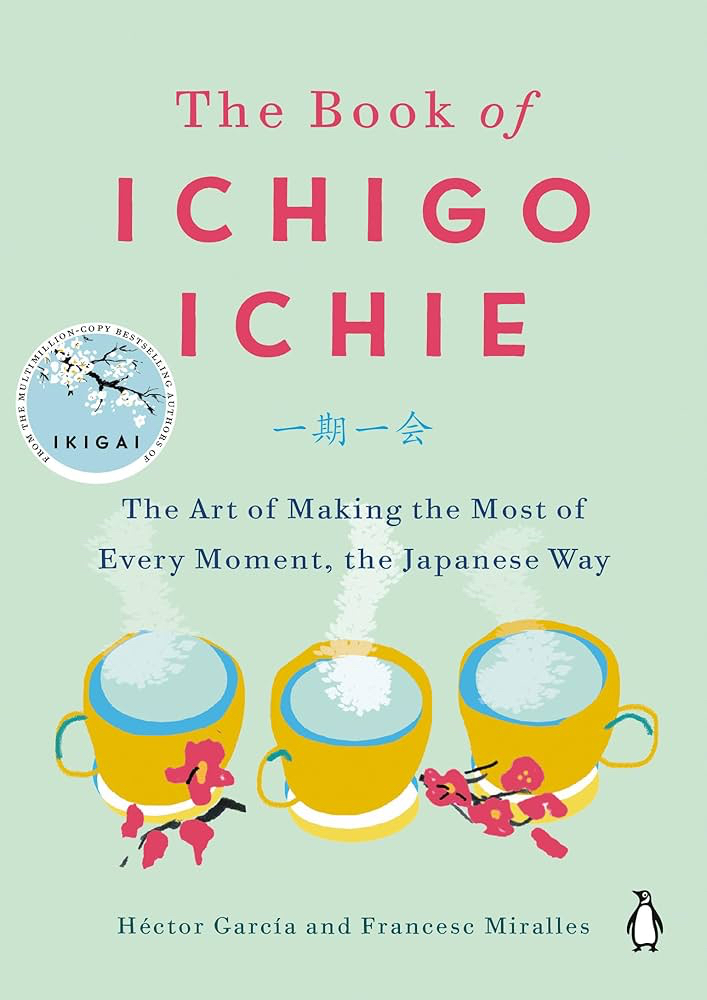
Author: Héctor García & Francesc Miralles
Genre: Philosophy / Mindfulness / Self-Development
Ideal For: Readers drawn to gentle, reflective books that encourage presence, gratitude, and intentional living. Perfect for fans of Japanese wisdom literature, slow living philosophies, and anyone feeling overwhelmed by modern life who wants a calmer way forward.
Introduction
The Book of Ichigo Ichie introduces readers to a beautiful Japanese concept: ichigo ichie, loosely translated as “one time, one meeting.” It’s the idea that every moment is unique, unrepeatable, and deserving of full presence. Even encounters that feel ordinary — a morning coffee, a conversation, a quiet walk — will never happen in exactly the same way again.
Rather than presenting this as an abstract philosophy, Héctor García and Francesc Miralles frame ichigo ichie as a practical mindset for daily life. The book asks a deceptively simple question: What would change if you treated every moment as singular and precious? The answer unfolds gently, chapter by chapter, through short reflections, anecdotes, and philosophical insights drawn from Japanese culture, Zen Buddhism, and the tea ceremony tradition.
This is not a book you rush through. It’s designed to be dipped into, lingered over, and returned to — ideally during moments when life feels too fast, too loud, or too fragmented.
Tone and Style: Calm, Accessible, and Intentionally Unhurried
García and Miralles write in a style that mirrors the philosophy they advocate. The prose is clear, soft, and unpretentious. There’s no urgency, no dramatic calls to overhaul your life overnight. Instead, the authors offer reassurance: you don’t need to escape your life to live meaningfully; you simply need to arrive in it.
Each chapter is short — sometimes only a few pages — and structured around a single idea. These ideas range from being fully present during meals, to approaching conversations without distraction, to letting go of regret about the past and anxiety about the future. The language is intentionally simple, making the book highly accessible even to readers unfamiliar with Eastern philosophy.
What stands out is the book’s refusal to moralise. It doesn’t scold you for checking your phone or failing to meditate. Instead, it gently invites you to notice what you’re missing — and to choose differently when you’re ready.
The Philosophy Behind Ichigo Ichie
At the heart of the book is the Japanese tea ceremony, where hosts and guests treat each gathering as a once-in-a-lifetime event. Even if the same people meet again, the exact conditions — the weather, the mood, the moment in life — will never repeat.
The authors use this tradition as a metaphor for everyday living. They argue that modern life, with its constant multitasking and digital distraction, trains us to treat moments as disposable. Ichigo ichie pushes back against that mindset, encouraging us to slow down and acknowledge the uniqueness of each experience.
Importantly, this philosophy is not about toxic positivity or forcing yourself to enjoy every moment. The authors acknowledge pain, grief, boredom, and frustration as inevitable parts of life. What ichigo ichie offers is not happiness at all costs, but awareness — the understanding that even difficult moments deserve attention and respect because they, too, are fleeting.
Key Themes Explored Throughout the Book
One of the strongest aspects of The Book of Ichigo Ichie is how it connects philosophy to everyday experience. The authors repeatedly return to a few central ideas, deepening them from different angles rather than presenting them as rigid rules.
Presence over productivity is a recurring theme. The book challenges the idea that worth comes from constant output, reminding readers that a fully lived moment has intrinsic value. Sitting quietly, listening deeply, or doing one thing at a time is framed not as laziness, but as a form of respect — for yourself and others.
Impermanence is another cornerstone. By accepting that nothing lasts forever — not relationships, not success, not pain — the book encourages a softer relationship with change. This awareness is meant to foster gratitude rather than fear, helping readers appreciate what they have while it’s here.
Attention as a form of love runs quietly through the book. Whether you’re speaking to a loved one or performing a routine task, the authors argue that giving your full attention is one of the most meaningful gifts you can offer. In this way, ichigo ichie becomes not just a personal philosophy, but a relational one.
Where the Book Truly Shines
The greatest strength of The Book of Ichigo Ichie lies in its emotional tone. It feels kind. There’s a warmth to the writing that makes it comforting rather than prescriptive. This is a book that meets you where you are — tired, distracted, searching — and offers gentle companionship rather than instruction.
It also excels as a gateway book. For readers new to mindfulness or Eastern philosophy, it provides an accessible introduction without jargon or spiritual intimidation. Concepts from Zen and Buddhism are explained simply, without requiring prior knowledge or belief.
Another highlight is how well the book works in small doses. You can read a chapter in a few minutes, reflect on it during the day, and return later for another. This makes it particularly well-suited for bedside reading, morning routines, or moments of emotional reset.
Where It Falls Slightly Short
While the book is undeniably soothing, its biggest limitation is also tied to its strength: repetition. Many chapters revisit similar ideas — presence, gratitude, impermanence — using different examples. For some readers, especially those already familiar with mindfulness literature, this can feel redundant.
The book also leans more toward reflection than action. While it offers thoughtful prompts and philosophical insights, it doesn’t provide structured exercises or step-by-step practices. Readers looking for a more hands-on approach to mindfulness may find it too abstract or light.
Additionally, the simplicity of the writing, while intentional, may leave some readers wanting greater depth. Complex emotional struggles — grief, trauma, existential anxiety — are touched upon, but not explored extensively. The book gestures toward these realities rather than dwelling in them.
Emotional Impact: Gentle but Genuine
The Book of Ichigo Ichie doesn’t aim to transform your life overnight — and that’s precisely why it works. Its emotional impact is cumulative rather than explosive. You may not finish it feeling dramatically changed, but you’re likely to notice subtle shifts: putting your phone down during a conversation, pausing before rushing through a meal, feeling a little more present in moments you previously skimmed over.
There’s something quietly reassuring about the book’s message that you don’t need to add anything to your life to make it meaningful. You simply need to notice what’s already there.
For readers experiencing burnout, anxiety, or decision fatigue, this book can feel like a deep exhale. It doesn’t deny the difficulty of modern life, but it offers a way to move through it with more grace and less urgency.
How It Compares to Similar Books
If you’ve read books like Ikigai (also by García and Miralles), The Things You Can See Only When You Slow Down, or Wabi Sabi, this book will feel familiar in tone and structure. What sets Ichigo Ichie apart is its laser focus on moments rather than purpose or aesthetics.
Where Ikigai asks why you live, Ichigo Ichie asks how you live — minute by minute, interaction by interaction. It’s less about finding a grand life mission and more about honoring the life you’re already in.
Who Will Love This Book
This book is especially well-suited for:
- Readers seeking calm, reflective reading rather than motivation or productivity hacks
- Those interested in Japanese philosophy and cultural concepts
- Anyone feeling overwhelmed, rushed, or disconnected from daily life
- Readers who enjoy short, meditative chapters they can revisit
It may be less appealing to readers who want practical frameworks, detailed psychological analysis, or fast-paced narrative nonfiction.
Final Thoughts: A Book That Asks You to Pause
The Book of Ichigo Ichie is a reminder, not a revelation. It doesn’t claim to unlock the secrets of happiness or solve life’s hardest problems. Instead, it offers something quieter and arguably more valuable: permission to slow down and be where you are.
Its message — that each moment is unrepeatable — isn’t new, but it’s delivered with sincerity and care. In a world that constantly urges us to optimise, multitask, and rush ahead, this book gently insists that now is enough.
It’s not a book you finish and shelve. It’s one you return to — when you’re feeling scattered, when you’re craving simplicity, or when you need to remember that even the smallest moments deserve attention.