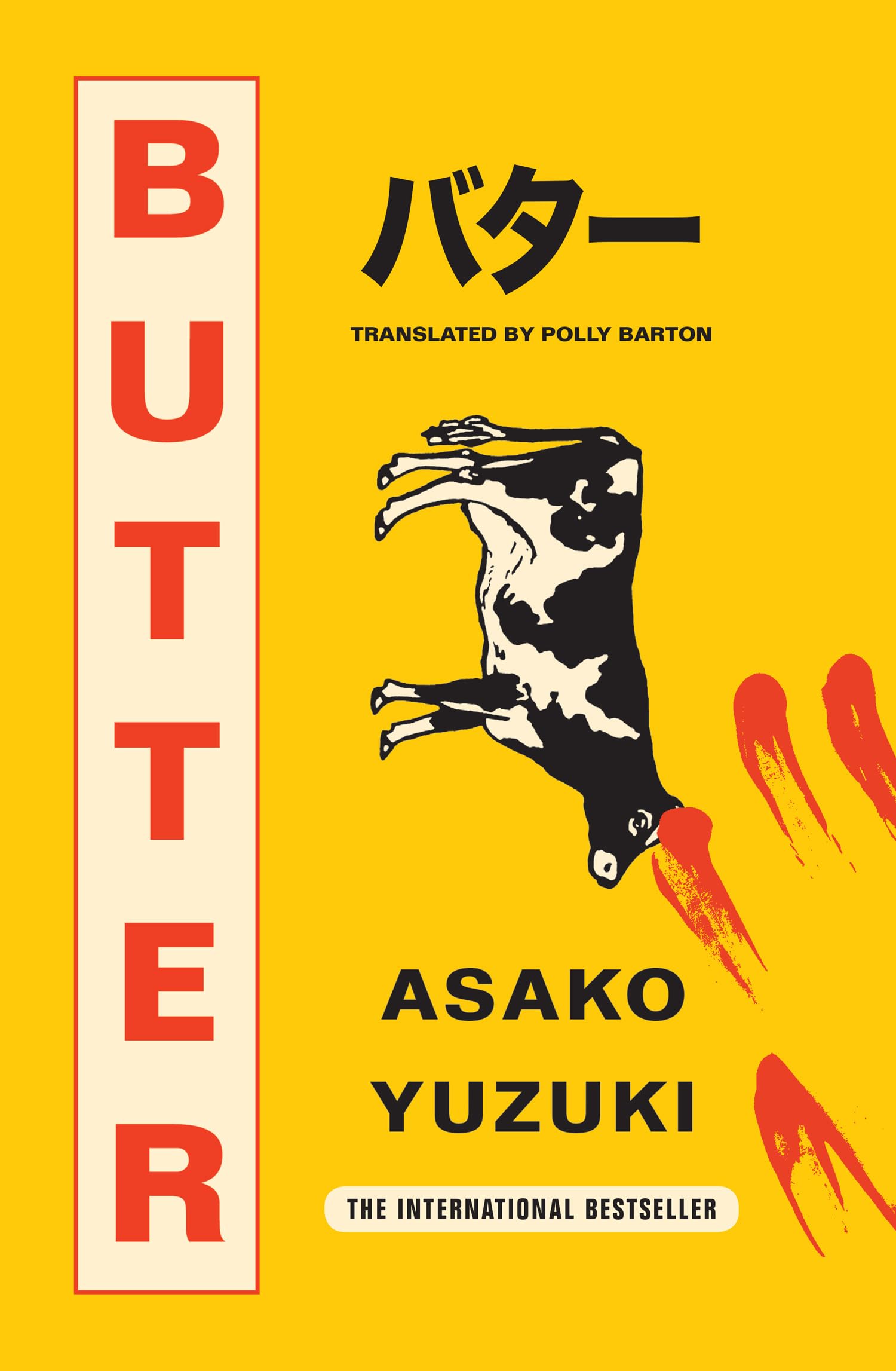
Author: Asako Yuzuki
Genre: Literary Fiction / Psychological Drama / Feminist Fiction
Ideal For: Readers who love intellectually rich novels that interrogate desire, power, food, and femininity. Perfect if you enjoy slow-burn psychological tension, morally complex women, and books that leave you thinking long after the final page.
Introduction
Butter is one of those rare novels that feels deceptively simple at first glance and then slowly, relentlessly reveals its depth. On the surface, it’s a story about food, a murder case, and an unlikely relationship between two women. In reality, it’s a sharp, unsettling examination of how society polices women’s bodies, appetites, and ambitions—and how easily desire becomes a crime when a woman refuses to be small.
Asako Yuzuki has written a novel that is at once sensual and cerebral, indulgent and restrained. It asks uncomfortable questions about who is allowed pleasure, who is punished for wanting too much, and how women are judged not just by what they do, but by what they consume—emotionally, socially, and literally.
The Premise: A Journalist, a Killer, and a Shared Appetite
The novel centers on Rika Machida, a Tokyo journalist stuck writing lightweight pieces for a magazine that caters to male readers. Rika is disciplined, restrained, and perpetually dieting—not just food, but her desires, her ambitions, her voice. She lives in a world where success for women requires self-denial, emotional moderation, and constant apology.
Then she becomes obsessed with Manako Kajii, a woman accused of seducing and murdering multiple men. Kajii is unapologetically fat, unapologetically feminine, and unapologetically indulgent. She cooks lavish meals. She eats butter without guilt. She refuses to conform to the expected script of remorse, modesty, or repentance.
Rika begins writing to Kajii in prison, hoping to secure an interview. What she gets instead is something far more destabilising: recipes, conversations, and a slow unravelling of everything she thought she knew about control, morality, and herself.
Food as Language, Weapon, and Liberation
Food in Butter is not decorative. It is central, symbolic, and confrontational. Yuzuki writes about butter, rice, stews, sauces, and textures with such precision that reading the novel feels almost tactile. You don’t just read about food—you feel it melting, sizzling, coating the tongue.
But food here is also ideology.
Kajii’s love of rich, traditionally “unhealthy” foods becomes a direct challenge to a culture obsessed with thinness, discipline, and female self-erasure. Butter—vilified, avoided, feared—becomes a metaphor for indulgence and defiance. To eat butter is to refuse shame. To savour it is to reclaim pleasure without permission.
Rika’s gradual shift—from ascetic eating to indulgent cooking—mirrors her internal transformation. As she cooks Kajii’s recipes, her life expands. She begins to feel hunger not just for food, but for autonomy, connection, and authenticity.
Two Women, Two Philosophies of Womanhood
The genius of Butter lies in how it positions Rika and Kajii as foils.
Rika is the “good” woman: hardworking, thin, socially acceptable, emotionally contained. She is praised for her restraint and punished for her ambition. Kajii is the “bad” woman: indulgent, manipulative, sexually confident, and uninterested in male approval beyond its utility.
Yet the novel constantly destabilises this binary.
Kajii may be a criminal, but she is also articulate, perceptive, and acutely aware of how gendered expectations shape public outrage. Rika may be free, but she is deeply constrained by internalised misogyny and fear of judgment.
Their relationship—conducted largely through letters and imagined intimacy—is electric not because it is romantic, but because it is revelatory. Kajii forces Rika to confront uncomfortable truths: about why women who enjoy food are mocked, why women who enjoy sex are vilified, and why ambition in women is so often reframed as selfishness or monstrosity.
Feminism Without Comfort or Slogans
Butter is a feminist novel, but it is not comforting or didactic. It does not offer clean answers or neat empowerment arcs. Instead, it interrogates feminism itself—especially its relationship with class, body politics, and moral judgment.
Yuzuki explores how even progressive spaces can reproduce the same hierarchies they claim to resist. Rika’s female colleagues judge Kajii harshly, not just for her crimes, but for her body and indulgence. Thinness becomes a moral virtue. Self-denial becomes proof of worth.
The novel asks: Why is restraint praised while pleasure is suspect? Why is female appetite—whether for food, power, or attention—treated as inherently dangerous?
These questions are never resolved. They linger, uncomfortable and unresolved, just as they do in real life.
Psychological Tension Without Sensationalism
Although Butter is loosely inspired by a real-life criminal case, it resists sensationalism. The murders are not the narrative’s focus. There are no graphic descriptions, no lurid details. Instead, the tension comes from psychology: from watching Rika slowly destabilise under Kajii’s influence, and from the reader’s constant uncertainty about Kajii’s true nature.
Is Kajii manipulating Rika? Almost certainly. Is she also telling uncomfortable truths? Absolutely. Is she guilty? The novel refuses to reduce her to innocence or guilt, instead asking why society is so eager to define her as a monster—and what that says about us.
The result is a thriller of ideas rather than action, where the most dangerous moments occur in conversations, letters, and quiet realizations.
Writing Style: Precise, Controlled, and Subtly Provocative
Yuzuki’s prose is deceptively restrained. She does not over-explain or dramatize. The sentences are clean, observational, and often understated—but beneath that surface simmers tension and irony.
Her descriptions of food are lush, but never indulgent for their own sake. They serve character and theme. Her portrayal of office politics, gendered labor, and media culture is sharp without being heavy-handed. Every detail feels deliberate.
The translation captures this balance beautifully, maintaining the novel’s cool tone while allowing its sensuality and critique to emerge organically.
The Body as Battleground
One of the most powerful aspects of Butter is its exploration of the female body as a site of social control. Kajii’s body is relentlessly scrutinised—by the media, the justice system, and the public. Her fatness becomes evidence of moral failure, excess, and deviance.
Rika, by contrast, is praised for her thinness—but that praise comes at the cost of constant surveillance and self-denial. Her body is acceptable only as long as it remains disciplined and unobtrusive.
Through these contrasts, the novel exposes how women are punished whether they conform or rebel. The rules are unwinnable. Pleasure is policed. Desire is suspect. And the body becomes both prison and protest.
Ambition, Work, and Invisible Labour
Beyond food and bodies, Butter also critiques workplace sexism and invisible labor. Rika is competent, driven, and intelligent, yet she is sidelined into writing trivial content because her editors believe “serious” journalism is not for women like her.
Her frustration is palpable. Her ambition is constantly redirected, softened, or dismissed. Kajii, who achieved a form of power through manipulation rather than institutional approval, becomes a distorted mirror of what happens when women seek influence outside acceptable channels.
The novel does not endorse Kajii’s actions—but it does force the reader to confront why transgressive women are often the only ones who seem to escape invisibility.
A Slow, Unsettling Transformation
Rika’s transformation is not triumphant or cathartic. It is slow, unsettling, and ambiguous. She does not emerge liberated in any simple sense. Instead, she becomes more aware—of her own compromises, her internalized judgments, and the costs of survival in a system not built for her.
This refusal to provide a clean empowerment narrative is one of the novel’s greatest strengths. Butter understands that awakening is not glamorous. It is uncomfortable. It destabilises relationships. It forces reckoning rather than resolution.
Why This Is a Five-Star Novel
Butter earns its five stars not because it is easy to love, but because it is impossible to forget.
It is intellectually rigorous without being academic, sensual without being indulgent, and feminist without being prescriptive. It trusts the reader to sit with discomfort, contradiction, and moral ambiguity.
Yuzuki has written a novel that challenges how we think about women who want too much—too much food, too much attention, too much power—and asks why that wanting feels threatening in the first place.
It is a book that sharpens your awareness. You will notice how people talk about bodies, appetites, and ambition differently after reading it. You will question your own judgments. You may even rethink your relationship with pleasure.
Final Thoughts: A Quietly Radical Masterpiece
Butter is not a comfort read. It does not reassure. It provokes.
It is a novel about hunger—in all its forms—and the systems that decide whose hunger is acceptable. It exposes the violence of restraint, the politics of food, and the moral panic that surrounds women who refuse to apologise for their desires.
Asako Yuzuki has crafted a work that is as precise as it is subversive, as elegant as it is unsettling. It is a book that lingers, not because of shock, but because of clarity.
If you are looking for a novel that respects your intelligence, challenges your assumptions, and offers no easy answers, Butter is essential reading.