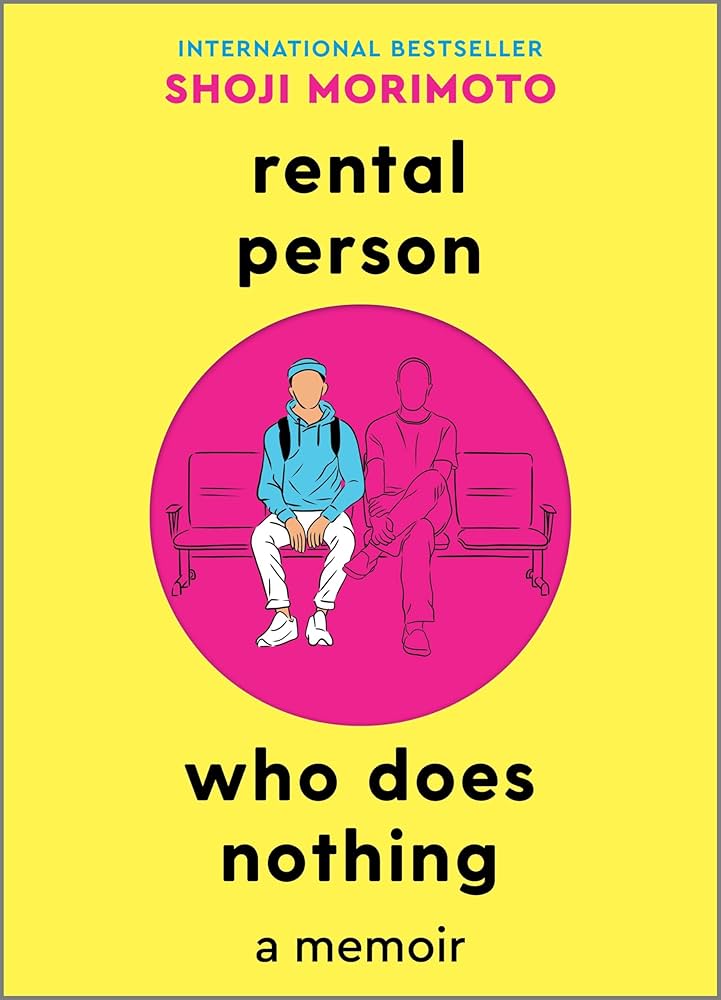
Author: Shoji Morimoto
Genre: Non-fiction / Memoir / Contemporary Japanese Culture
Ideal For: Readers drawn to quiet, contemplative books about modern loneliness, work culture, and human connection. Perfect for fans of reflective Japanese non-fiction, minimalism, and books that gently question what it means to be “useful” in today’s world.
What If Doing Nothing Was the Point?
At first glance, Rental Person Who Does Nothing sounds like a novelty — a quirky premise destined for a few viral headlines and then forgotten. A man who offers his presence, but no labour. A person you can hire to accompany you to dinner, sit silently beside you, attend an event, or simply exist nearby, without conversation or obligation.
But Shoji Morimoto’s memoir is anything but a gimmick.
Instead, it is one of the most quietly radical, tender, and thought-provoking books about modern life, loneliness, and self-worth you will read. What begins as an unconventional service slowly unfolds into a profound meditation on connection, capitalism, identity, and the human need to be seen — without being judged or fixed.
This is not a book about idleness. It is a book about presence.
The Premise: Renting a Human, Not a Service
Morimoto, once a regular salaryman in Tokyo, found himself struggling in traditional work environments. He was frequently told that he contributed “nothing” — that he lacked initiative, ambition, or usefulness in a culture that prizes productivity and visible effort. Instead of fighting this label, he leaned into it.
He began offering himself as a “rental person who does nothing.”
Clients could pay him a modest fee to accompany them — to a park, a hospital visit, a divorce proceeding, a wedding, a meal. He would not give advice. He would not judge. He would not intervene unless asked. He would simply be there.
Over time, thousands of people reached out to him. And with each interaction, Morimoto discovered something startling: doing nothing was not nothing at all.
A Book Built on Small Moments
The structure of the book mirrors its philosophy. Rather than a linear autobiography, Rental Person Who Does Nothing is composed of short vignettes — snapshots of encounters with clients, reflections on work, and gentle observations about society.
A woman rents him to sit beside her while she eats lunch alone.
A man hires him to attend a difficult family meeting.
Someone asks him to accompany them while they scatter ashes.
Another client just wants someone to watch them cry.
These moments are understated, often described in a matter-of-fact tone. And yet, they carry immense emotional weight. Morimoto never sensationalises his clients’ pain or turns their vulnerability into spectacle. Instead, he writes with restraint, allowing the simplicity of presence to speak for itself.
What emerges is a portrait of a society overflowing with people who don’t need solutions — they need acknowledgment.
Morimoto’s Voice: Calm, Observant, and Gently Disarming
Morimoto’s writing style is quintessentially Japanese in its minimalism. His prose is plain, unadorned, and quietly precise. He does not dramatise or moralise. He rarely draws sweeping conclusions. Instead, he presents experiences as they are and trusts the reader to feel their significance.
This restraint is exactly what gives the book its power.
There is no performative wisdom here. Morimoto does not frame himself as a guru or philosopher. In fact, he often positions himself as uncertain, passive, even confused by his own success. That humility makes the book deeply human.
He observes rather than explains. He listens rather than instructs. And in doing so, he invites the reader to sit beside him — much like his clients do — and reflect.
Themes That Linger Long After the Last Page
1. The Tyranny of Productivity
One of the book’s most striking themes is its critique of modern work culture. In a society where value is often equated with output, Morimoto’s existence feels subversive. He challenges the assumption that worth must be earned through efficiency, hustle, or visible contribution.
By offering “nothing,” he exposes how desperate people are for something that can’t be quantified: companionship without expectation.
This is not an anti-work manifesto, but a quiet dismantling of the idea that humans exist to perform.
2. Loneliness in Plain Sight
Many of Morimoto’s clients are not socially isolated in the traditional sense. They have jobs, families, friends. And yet, they feel profoundly alone.
The book captures a specific kind of modern loneliness — the loneliness of being surrounded by people who are too busy, too distracted, or too uncomfortable with vulnerability to simply sit with another person’s feelings.
Morimoto’s presence becomes a rare, safe space. Not because he fixes anything, but because he doesn’t try to.
3. The Power of Being Witnessed
Again and again, the book returns to the idea that being seen — truly seen — can be transformative. Morimoto does not validate or invalidate his clients’ emotions. He bears witness to them.
There is something radical in this restraint. In a world obsessed with commentary, advice, and hot takes, Morimoto offers silence and attention.
The book suggests that sometimes, that is enough.
4. Redefining Help
What does it mean to help someone?
Morimoto’s work complicates this question. He does not intervene. He does not solve problems. And yet, many clients report feeling lighter, calmer, less alone after spending time with him.
The book invites readers to reconsider how often our urge to help is actually an urge to control, to fix, to justify our presence. Morimoto’s model suggests another option: help as accompaniment.
The Emotional Undercurrent: Quiet, But Deep
Despite its calm tone, Rental Person Who Does Nothing is emotionally rich. There are moments that will catch you off guard — not through melodrama, but through recognition.
You may see yourself in the client who hires Morimoto just to avoid eating alone.
Or in the person who wants someone present during a difficult milestone.
Or even in Morimoto himself — uncertain, drifting, trying to find a place in a world that values loud certainty.
The book gently asks: How many of us feel we are “doing nothing” in ways that matter? And what if that feeling isn’t failure, but misalignment?
Cultural Context: A Window Into Contemporary Japan — and Beyond
While deeply rooted in Japanese society, the book’s themes are universal. Japan’s intense work culture, social expectations, and emotional restraint provide a specific backdrop, but the questions Morimoto raises resonate globally.
In cities everywhere, people feel unseen. In economies everywhere, worth is measured by productivity. In relationships everywhere, silence is uncomfortable.
This book travels well because it speaks to something shared: the longing to exist without explanation.
Why This Book Feels So Necessary Right Now
In an era of burnout, hyper-visibility, and constant self-optimization, Rental Person Who Does Nothing feels like an antidote.
It doesn’t tell you to quit your job, move to the countryside, or reject society. Instead, it quietly asks you to question the stories you’ve absorbed about usefulness, success, and value.
It reminds you that presence is not passive. That attention is not trivial. That being with someone — without agenda — is increasingly rare and deeply meaningful.
A Note on What This Book Is Not
This is not a self-help book with steps or strategies. It will not tell you how to live your life. It will not wrap its insights in motivational language.
Some readers may find the lack of structure or resolution frustrating. Others may wish Morimoto delved more deeply into his own inner struggles.
But these absences feel intentional. The book practices what it preaches. It leaves space.
Why It Deserves Five Stars
Rental Person Who Does Nothing earns its five-star rating not because it is loud or dramatic, but because it is quietly transformative.
It offers a new vocabulary for thinking about connection.
It reframes “doing nothing” as a form of care.
It validates the human need to be accompanied without being improved.
Few books manage to change the way you think about everyday interactions — how you sit with a friend, how you listen, how you measure your own worth. This one does.
It’s a book you finish slowly. A book you think about when you’re sitting beside someone on a train. A book that lingers in silence.
The Lasting Impact
After reading this book, you may find yourself resisting the urge to fill silence. You may sit with discomfort longer. You may offer presence instead of advice.
You may also look at your own life differently — questioning the moments you’ve dismissed as unproductive, unimportant, or empty.
Morimoto suggests, gently, that those moments might be where meaning lives.
Final Thoughts: A Radical Kind of Stillness
Rental Person Who Does Nothing is not about a strange job. It’s about a different way of being human.
In a world that constantly asks, What do you do?, this book dares to ask, Who are you when you don’t do anything at all?
Shoji Morimoto has written a memoir that feels less like a statement and more like an invitation — to sit, to listen, to exist alongside others without justification.
It is rare. It is beautiful. And it is deeply, quietly unforgettable.