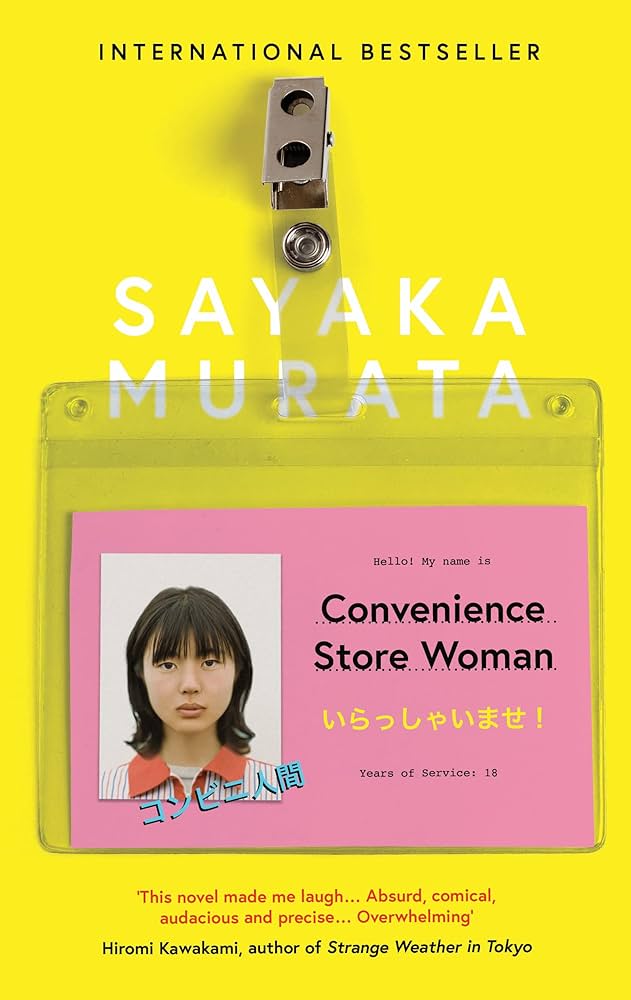
Book: Convenience Store Woman
Author: Sayaka Murata
Genre: Literary Fiction / Contemporary Japanese Literature
Ideal For: Readers who love sharp, unconventional fiction that quietly dismantles social norms. Perfect for anyone who’s ever felt out of sync with expectations around work, marriage, success, or “normal” adulthood.
A Small, Strange Book With Enormous Power
Convenience Store Woman is one of those rare novels that looks deceptively simple on the surface but leaves a deep, unsettling echo long after you finish it. Slim in length yet immense in insight, Sayaka Murata’s internationally acclaimed novel examines modern society’s obsession with conformity through the life of a woman who has chosen — or perhaps instinctively accepted — a path others deem inadequate.
This is not a story about transformation in the conventional sense. There is no glow-up, no triumphant rebellion, no neat moral bow. Instead, Convenience Store Woman asks a far more uncomfortable question: What if the problem isn’t the woman who doesn’t fit in — but the world that insists she must?
The Premise: A Life Lived Perfectly… Wrong
Keiko Furukura is 36 years old and has worked part-time at the same convenience store in Tokyo for 18 years. She is single, childless, uninterested in romance, and deeply content arranging shelves, greeting customers, and following the store manual to the letter.
To Keiko, the convenience store is not a stepping stone or a temporary job — it is a complete ecosystem, a place where rules are clear, expectations are precise, and harmony is achievable. She calibrates her voice to match her coworkers, mimics facial expressions to blend in, and takes immense pride in performing her role flawlessly.
But to everyone else — her family, her former classmates, society at large — Keiko is a problem to be solved.
Why hasn’t she gotten married?
Why doesn’t she want a “real” job?
Why isn’t she trying to be normal?
As these questions intensify, Keiko begins to feel external pressure to change — not because she wants to, but because the world demands it.
Sayaka Murata’s Voice: Precise, Unsettling, and Brilliantly Deadpan
Murata’s writing is razor-sharp in its restraint. She does not tell you what to think; she shows you a life lived according to rules that make sense to the protagonist, even when they horrify or confuse others. The prose is clean, almost clinical, which mirrors Keiko’s worldview — emotions are processed intellectually, not sentimentally.
This flatness is not coldness. It’s intentional. Murata uses Keiko’s detached narration to expose how arbitrary social norms truly are. The result is darkly funny, deeply uncomfortable, and profoundly revealing.
Lines that should sound absurd are delivered matter-of-factly, making them feel disturbingly logical. Keiko does not rebel against society — she simply does not understand why it operates the way it does.
And in that misunderstanding lies the novel’s power.
A Protagonist Unlike Any Other
Keiko Furukura is one of the most memorable protagonists in modern literature because she refuses to perform relatability. She is not quirky in a charming way, nor is she positioned as someone waiting to “find herself.” She already knows who she is.
From childhood, Keiko has struggled to respond appropriately to social situations. She doesn’t instinctively grasp why certain behaviors are unacceptable, only that they are. So she learns to copy others — adopting speech patterns, facial expressions, and moral frameworks like software updates.
What society labels as dysfunction, Keiko experiences as efficiency.
The convenience store becomes her sanctuary because it offers something the outside world does not: a manual. A clear set of rules for how to exist. When she is working, she feels alive, useful, complete.
Murata never diagnoses Keiko. She never labels her. And that absence is crucial. The novel resists the urge to medicalise difference, instead asking readers to consider whether Keiko’s way of living is truly inferior — or simply incompatible with societal expectations.
Work, Identity, and the Myth of Progress
One of the novel’s most incisive critiques is its examination of work as identity. Keiko’s job is considered temporary, juvenile, embarrassing — a sign of failure. But Murata flips the script by asking: Why?
Keiko works diligently. She contributes. She excels. She finds meaning. And yet, because her job lacks status, she is seen as incomplete.
Through Keiko’s interactions with coworkers, family members, and acquaintances, Murata exposes how deeply capitalist notions of progress are embedded in personal worth. Full-time employment, promotions, marriage, and children are framed not as choices, but as obligations.
Anyone who deviates is treated with suspicion.
The irony is devastating: Keiko is one of the few characters who is genuinely content, yet she is the one constantly urged to change.
The Introduction of Shiraha: A Mirror of Misogyny
Midway through the novel, Murata introduces Shiraha, a bitter, unemployed man who joins the convenience store staff. Where Keiko adapts to society by imitation, Shiraha openly resents it. He views women as tools for survival and believes society has wronged him by not rewarding his perceived superiority.
Their relationship is transactional, awkward, and deeply unsettling — and deliberately so.
Shiraha functions as a mirror, showing two different responses to social alienation. Keiko internalises and adapts. Shiraha externalises and blames. Society is more forgiving of Shiraha’s ambition than Keiko’s contentment, despite his cruelty and entitlement.
This contrast sharpens the novel’s feminist edge. Murata exposes how women are expected to perform happiness in prescribed ways — and punished when they don’t.
Humour That Cuts Close to the Bone
Convenience Store Woman is often described as quirky or humorous, but its humour is not light. It is observational, dry, and surgical. You laugh — and then immediately feel uncomfortable for doing so.
Scenes where Keiko rehearses appropriate responses, or where characters offer well-meaning but invasive advice, feel painfully familiar. Murata captures the subtle violence of “concern,” the way it disguises judgment as care.
The humour works because it is truthful. It reveals how absurd many social rituals are when stripped of emotional justification.
A Feminist Novel Without Slogans
Murata’s feminism is quiet but devastating. She never preaches. She simply presents a woman who refuses to want what she’s supposed to want — and lets the consequences unfold.
Keiko is not punished by the narrative. She is punished by society.
The novel interrogates the idea that fulfilment must follow a specific script: education, career, marriage, motherhood. By presenting a protagonist who rejects this script without apology, Murata destabilises it entirely.
This is not a story about empowerment through ambition. It’s about empowerment through self-knowledge — even when that knowledge is inconvenient.
The Ending: Radical in Its Refusal
Without spoiling anything, the ending of Convenience Store Woman is one of the boldest choices Murata could have made. It does not offer redemption in the form readers might expect. There is no compromise designed to make Keiko more palatable.
Instead, the ending affirms Keiko’s internal logic.
It is radical precisely because it refuses transformation as a moral necessity. In a literary landscape obsessed with growth arcs, Murata dares to ask: What if staying the same is not a failure?
The answer is quietly revolutionary.
Why This Book Feels Even More Relevant Today
In an era of burnout culture, hustle ideology, and curated lives, Convenience Store Woman feels prophetic. It speaks to anyone who has felt alienated by the demand to constantly upgrade themselves.
It resonates with readers navigating precarious labor, alternative lifestyles, neurodivergence, and the exhaustion of performing normalcy.
Murata’s novel does not romanticise isolation — but it does challenge the idea that belonging must be earned through conformity.
Final Thoughts: A Quiet Classic of Modern Literature
Convenience Store Woman is short, sharp, and endlessly discussable. It’s the kind of book that makes you question your assumptions — about success, happiness, womanhood, and what it means to live a “good” life.
Sayaka Murata has written a novel that feels both deeply personal and universally relevant. It does not shout its message. It hums it steadily, like the fluorescent lights of a convenience store at midnight — constant, unglamorous, and impossible to ignore.
This is not just a five-star read. It’s a book that changes how you look at the world.