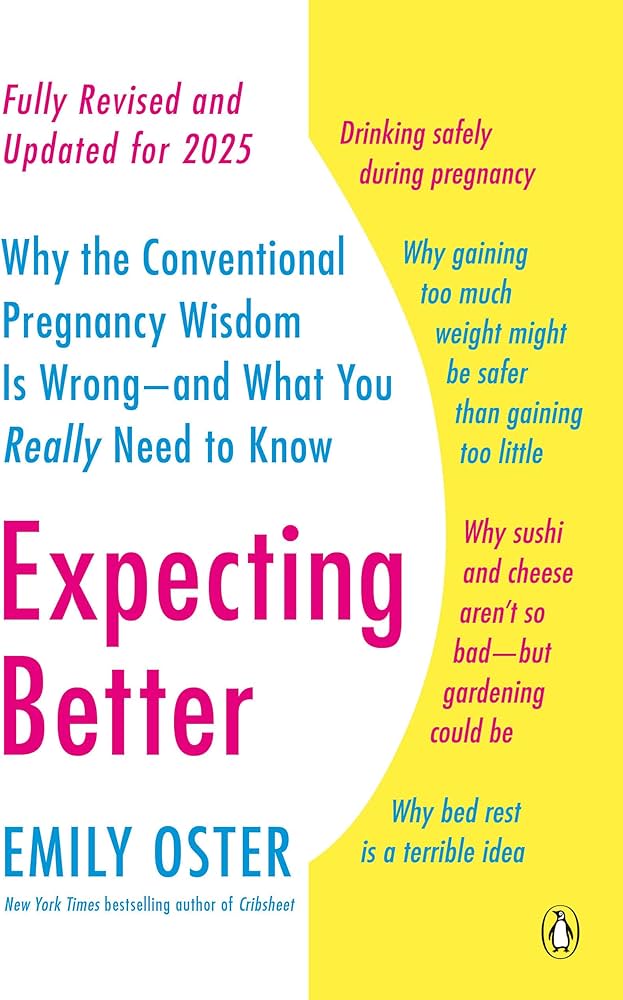
Author: Emily Oster
Genre: Parenting / Pregnancy / Evidence-Based Non-Fiction
Ideal For: Expecting parents who want clarity instead of fear, data instead of dogma, and reassurance without condescension. Perfect for readers who feel overwhelmed by pregnancy “rules” and want to make informed choices that fit their real lives.
Introduction
Expecting Better is not a typical pregnancy book. It doesn’t scold, catastrophise, or drown you in absolutes. Instead, Emily Oster does something radical in the parenting world: she hands readers the data, explains what it actually means, and trusts them to decide for themselves.
First published in 2013 and still profoundly relevant, Expecting Better has become a modern classic for a reason. Oster, an economist by training, approaches pregnancy the way she would any complex decision-making problem—by interrogating the evidence, questioning assumptions, and separating correlation from causation. The result is a book that feels less like a rulebook and more like a calm, intelligent conversation with someone who respects your agency.
This is a five-star read not because it tells you what to do, but because it empowers you to understand why recommendations exist—and when they don’t hold up.
The Premise: Data Over Dogma
Oster begins with a simple but powerful question: Why are pregnant women given so many rules without explanations? No coffee. No sushi. No wine. No deli meat. Don’t sleep this way. Don’t exercise that way. Don’t stress. Don’t gain too much weight—but don’t gain too little either.
Rather than accepting these directives at face value, Oster investigates the studies behind them. She digs into epidemiology, statistical bias, sample sizes, and risk ratios, translating complex research into language that’s accessible without being simplistic.
What she discovers—and shows the reader—is that many pregnancy “rules” are based on weak evidence, outdated studies, or extreme risk-aversion rather than clear data. Others are supported by strong evidence, but are often poorly explained. Expecting Better is about distinguishing between the two.
Tone and Voice: Calm, Clear, and Reassuring
One of the book’s greatest strengths is its tone. Oster never sounds smug or dismissive. She doesn’t belittle traditional advice, nor does she encourage reckless behavior. Instead, she adopts a tone that is calm, analytical, and quietly compassionate.
She acknowledges the anxiety that often accompanies pregnancy—especially in cultures that treat pregnant bodies as public property subject to endless commentary. Her writing feels like a steadying hand on your shoulder. You don’t come away feeling judged; you come away feeling capable.
The voice is refreshingly adult. Oster assumes her readers are intelligent, curious, and able to handle nuance. She explains concepts like relative risk and confounding variables without oversimplifying, and she trusts readers to engage with uncertainty rather than demand false certainty.
Key Topics Oster Reframes Brilliantly
Alcohol and Caffeine
Perhaps the most controversial sections of the book, Oster’s analysis of alcohol and caffeine consumption during pregnancy is also one of the most liberating. She carefully examines the research on fetal alcohol syndrome and low-level alcohol intake, showing where the data is strong—and where it simply isn’t.
Rather than declaring “it’s fine” or “it’s dangerous,” Oster presents the actual risk levels and acknowledges the limits of existing studies. The same goes for caffeine. The result is not permission, but perspective.
This approach reduces guilt and fear while still respecting risk. It allows readers to make informed, personal decisions rather than blindly following blanket bans.
Food Rules and Listeria Panic
Oster dismantles the logic behind many food restrictions by focusing on actual risk sources. She shows that some foods pregnant women are told to avoid carry less risk than foods they’re encouraged to eat—and that context matters far more than lists.
This section alone has transformed how countless readers approach pregnancy nutrition, shifting the focus from paranoia to practicality.
Weight Gain and Exercise
Instead of moralizing weight gain, Oster looks at the data behind recommended ranges and outcomes. She shows how pre-pregnancy BMI, overall health, and individual circumstances matter far more than rigid numbers.
Her discussion of exercise is similarly grounded. Rather than promoting fear or extremes, she emphasises moderation, evidence, and listening to one’s body—again backed by data, not anecdote.
Prenatal Testing and Screening
Oster handles prenatal testing with particular sensitivity. She explains the purpose, accuracy, and limitations of various tests without pushing a particular moral stance.
This section is especially powerful because it respects that these decisions are deeply personal. By laying out probabilities and false-positive rates clearly, Oster helps readers engage with these choices thoughtfully rather than reactively.
What Makes This Book So Important
It restores autonomy.
Pregnancy advice often strips people of agency, replacing choice with fear. Expecting Better returns decision-making power to the reader, grounded in understanding rather than anxiety.
It reduces unnecessary guilt.
Many readers report feeling immense relief while reading this book. Not because it encourages risky behavior, but because it dismantles the idea that one misstep equals catastrophe.
It changes how readers think—not just what they do.
Oster doesn’t just provide pregnancy advice; she teaches readers how to evaluate evidence. That skill extends far beyond pregnancy, influencing how readers approach parenting, health, and risk more broadly.
It respects complexity.
There are no simplistic answers here. Oster repeatedly emphasises that data rarely gives us certainty—only better questions and clearer trade-offs.
The Writing: Clear, Structured, and Surprisingly Engaging
Despite dealing with statistics and studies, Expecting Better is remarkably readable. Oster’s explanations are crisp and well-paced, often supported by charts, examples, and analogies that make abstract concepts tangible.
She structures the book logically, moving through pregnancy chronologically while also grouping topics thematically. This makes it easy to read cover to cover or dip into as needed.
There’s also a quiet humour running through the text—dry, self-aware, and never distracting. Oster is willing to poke fun at both alarmist advice and her own academic instincts, which keeps the book human and approachable.
Who This Book Is (and Isn’t) For
This book is ideal for readers who:
- Feel overwhelmed by conflicting pregnancy advice
- Want evidence-based explanations, not commandments
- Appreciate nuance and intellectual honesty
- Prefer empowerment over reassurance-by-fiat
It may not be ideal for readers who:
- Want strict rules and absolute answers
- Find uncertainty anxiety-inducing
- Prefer traditional pregnancy manuals with step-by-step directives
That said, even readers who initially resist Oster’s approach often find themselves reassured by her careful, respectful reasoning.
Why It Earns Five Stars
Expecting Better earns its five-star rating because it fundamentally improves the pregnancy reading landscape. It doesn’t just add another voice—it changes the conversation.
- Originality: Few pregnancy books question the foundations of advice so thoroughly.
- Clarity: Complex data is made understandable without distortion.
- Respect: Readers are treated as capable decision-makers.
- Impact: The book has changed how millions approach pregnancy, parenting, and risk.
- Longevity: More than a decade after publication, it remains relevant and widely recommended.
This is one of those rare non-fiction books that genuinely alters how readers think—not by persuading them of a position, but by equipping them with tools.
The Emotional Undercurrent: Calm in a Culture of Fear
Perhaps the most underrated achievement of Expecting Better is emotional. Pregnancy culture is saturated with fear—fear of doing something wrong, fear of judgment, fear of irreversible harm.
Oster doesn’t dismiss these fears. She contextualises them. By showing that many risks are smaller than they’re presented—and that others deserve more attention—she replaces vague anxiety with proportional understanding.
The emotional effect is profound. Readers often describe feeling calmer, more confident, and more grounded after reading this book. That alone makes it invaluable.
Final Thoughts: A Book That Trusts You
Expecting Better is not about being perfect. It’s about being informed. It acknowledges that pregnancy happens in real lives—with jobs, relationships, cultures, and constraints.
Emily Oster doesn’t promise certainty. She offers clarity. She doesn’t remove risk. She explains it. And in doing so, she gives readers something far more powerful than reassurance: confidence in their own judgment.
This is not just one of the best pregnancy books available—it’s one of the most respectful. It assumes that expecting parents are not fragile vessels of anxiety, but thoughtful individuals capable of weighing evidence and making decisions that align with their values.