Author: Witold Szabłowski
Genre: Narrative Nonfiction / Political History / Food & Culture
Ideal For: Readers who love nonfiction that blends culinary storytelling with political intrigue, fans of Anthony Bourdain–style travel writing, and anyone who wants a chilling yet surprisingly intimate look at how authoritarian power shapes private lives.
Plot Summary
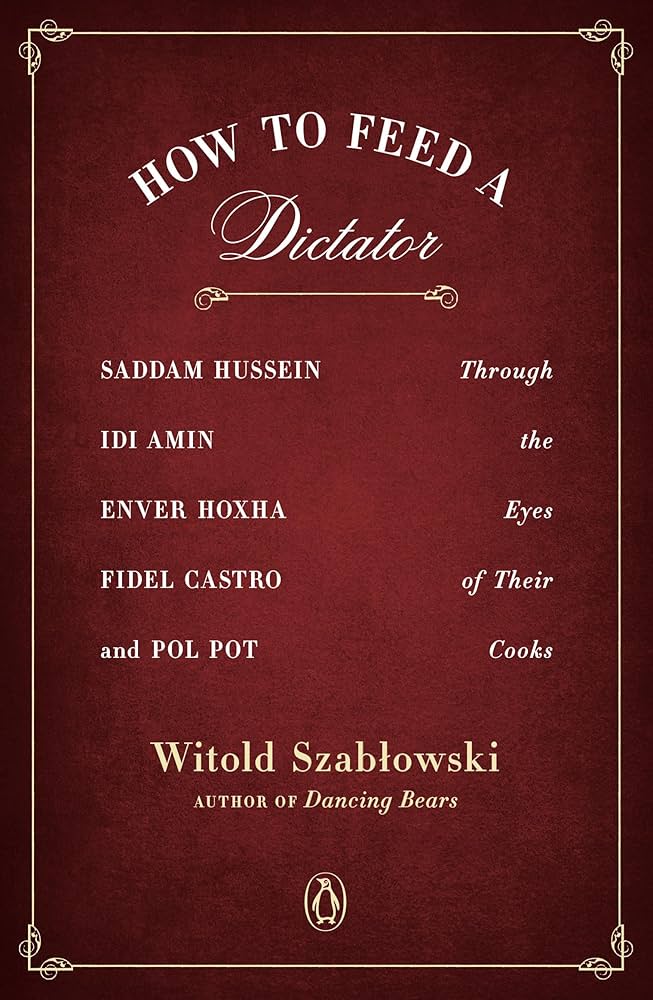
Witold Szabłowski’s How to Feed a Dictator is one of those rare nonfiction books that feels simultaneously outrageous, insightful, darkly funny, and deeply unsettling. The premise is simple but brilliant: Szabłowski travels the world to interview the personal chefs of some of the most infamous dictators of the 20th century — Saddam Hussein, Pol Pot, Idi Amin, Fidel Castro, and Enver Hoxha — and asks a deceptively simple question: What was it like to cook for a man who inspired fear, awe, devotion, and mass violence?
The result is a book that offers an entirely new lens on power. Szabłowski is not trying to excuse dictators or reinterpret their crimes. Instead, he brings readers into the kitchens, dining rooms, secret tunnels, and food rituals that shaped their daily lives, showing that even the most monstrous figures have mundane habits, eccentric tastes, and private vulnerabilities. This humanising perspective does not lighten the horror; if anything, it intensifies it.
What emerges is a portrait of authoritarianism not through speeches or political analysis but through menus, cooking techniques, paranoia, hunger, abundance, and fear. Food becomes an entry point into the psychology of repression.
A Narrative That Moves Like a Documentary and Reads Like a Novel
Szabłowski’s book unfolds through five long-form profiles, each centered on a chef who once served history’s most feared leaders. These chefs are not famous figures; they are ordinary people who happened to be close — sometimes too close — to power. Their stories are not polished; they are raw, surprising, contradictory, and tinged with trauma.
Szabłowski writes with journalistic restraint, but the scenes feel cinematic. You can practically see the smoke-filled kitchens, feel the weight of the silence in a dictator’s dining room, and hear the strange, almost tender conversations that happen in moments when political power and personal loyalty blur.
Each chef’s section plays out like a documentary: uninterrupted, immersive, and emotionally charged. For readers who enjoy narrative nonfiction that feels alive on the page, this structure is incredibly engaging.
Saddam Hussein’s Chef: Terror Mixed With Routine
One of the most gripping sections focuses on Saddam Hussein’s personal chef, Abu Ali, who cooked for the Iraqi dictator for over thirty years. His anecdotes reveal a dictator obsessed with security and distrust — a man who loved simple dishes like fresh fish and rice but lived in constant fear of being poisoned.
Abu Ali recounts moments when Saddam seemed warm and paternal, only to become distant and terrifying in the next breath. The intimacy of preparing his meals — and the absolute terror of making a mistake — creates a tension that permeates every page.
This chapter is one of the most psychologically intense, revealing how authoritarian power demands loyalty but offers nothing in return.
Pol Pot’s Chef: The Banality of Evil in Rural Comfort
Pol Pot’s chef grew up with him, knew him before the purges, and even after the genocide saw him as a gentle, grandfatherly figure. This cognitive dissonance is chilling. Szabłowski does not intervene with commentary or judgment; he lets the testimony speak for itself.
What makes this section so disturbing is its calmness. The chef describes simple meals, polite dinner conversations, and countryside walks — while the reader is painfully aware that millions were dying at that very moment under Pol Pot’s orders.
The effect is devastating: evil is not always loud or dramatic. Sometimes it is served with tea.
Idi Amin’s Chef: Chaos, Humour, and Horror
Idi Amin’s section is the wildest — a blend of comedic absurdity and genuine fear. The chef describes Amin as unpredictable, violent, and eccentric. One moment Amin is joking or dancing, the next he is unleashing brutal punishments.
This chapter reads almost like satire, until the emotional weight of the chef’s trauma emerges. The chaos of Amin’s regime is reflected in his food preferences, demands, and whims. Through these anecdotes, Szabłowski captures the surreal nature of life under a dictator who was as theatrical as he was deadly.
Fidel Castro’s Chef: Ideology Cooked Into Every Meal
Castro’s chef, elevated to near-celebrity status in Cuba, reveals a world shaped by political theater. Food becomes a tool of propaganda — meals designed to reflect austerity, revolution, or international diplomacy.
Unlike the other dictators, Castro’s image is tied to ideology rather than fear alone. Szabłowski explores how food became a symbol of national identity and political purity. This section is intellectually fascinating, contrasting private indulgence with public messaging.
Enver Hoxha’s Chef: Isolation and Paranoia
Hoxha, the dictator of Albania, lived in near-total isolation. His chef’s story reflects the suffocating paranoia that defined his regime. Even meals were examined for ideological purity.
Szabłowski uses this section to show how authoritarianism shrinks the world — how fear creates small, suffocating lives, even for those closest to the dictator.
A Book About Dictators That Is Mostly About Ordinary People
The most powerful part of How to Feed a Dictator is not the dictators — it’s the chefs. These men lived through unimaginable moral contradictions. They served meals to men the world considers monsters, yet they speak of loyalty, fear, affection, or denial. Their stories remind us that authoritarianism traps everyone — even those who appear close to power.
Szabłowski never manipulates their narratives. He lets them be contradictory and human. This is the book’s greatest strength: its refusal to simplify.
The chefs’ memories are fragmented, sometimes self-protective. They make excuses, express doubts, reveal trauma, and occasionally cling to delusions. Szabłowski gives them space to speak, and in doing so, he reveals how ordinary people survive extraordinary evil.
Writing Style: Sharp, Evocative, Unforgettable
Szabłowski’s writing oscillates between journalistic clarity and novelistic richness. He brings environments to life — deserts, jungles, cramped kitchens, palatial dining rooms — with vivid sensory detail. But he also knows when to step back and let a moment unfold without embellishment.
His restraint is admirable. He never sensationalises violence or trauma. Instead, he builds tension through what goes unsaid: the silence before a dictator tastes his food, the shadow of soldiers outside the kitchen door, the fear that one wrong ingredient can end a life.
Every chapter is rich in storytelling, yet precise in language. The pacing is strong, though occasionally repetitive due to the interview-based structure — one of the reasons this review awards four stars instead of five.
A Meditation on Power, Fear, and Food
Food is the book’s anchor, but it is also metaphor. Cooking for someone requires proximity, trust, and care — even when that someone is responsible for mass suffering. The act of feeding becomes symbolic:
- Food as control
- Food as manipulation
- Food as love, fear, or ritual
- Food as a mask for violence
Szabłowski explores these layers without moralising. He shows how meals take on political meaning in authoritarian regimes — how dictators use food to display power or humanity, and how chefs become both confidantes and prisoners.
Why It’s a Four-Star Read
This book deserves immense praise for its originality, emotional weight, and narrative skill. But a few aspects keep it from five stars:
- The interview-based format can occasionally feel repetitive. Each dictator’s story stands alone, but some structural patterns overlap.
- Readers wanting deeper political analysis may crave more context. Szabłowski focuses on personal narrative, sometimes at the expense of broader historical framing.
- The emotional detachment of some chefs may frustrate readers. But this is also part of the book’s brilliance — the contradictions are real, not manufactured.
Despite these small limitations, How to Feed a Dictator remains one of the most haunting and innovative nonfiction books of the past decade.
Final Thoughts: A Necessary, Unsettling, Masterfully Told Work
Witold Szabłowski has written a book unlike any other. How to Feed a Dictator is gripping, deeply human, morally complex, and unforgettable. It forces readers to confront uncomfortable truths about power: that dictators are not mythical beings, but humans with appetites, routines, and people who serve—or fear—them.
By centering the chefs, Szabłowski reveals the hidden intimacy of authoritarianism. These men lived close enough to see the cracks, the fears, the strange comforts of monstrous leaders. Through their stories, we witness how ordinary people navigate systems designed to crush individuality.
It’s a book that lingers. Long after finishing, you’ll find yourself thinking about the chefs’ faces, their voices, their contradictions — and the strange, chilling realisation that sometimes the closest witness to a dictator’s cruelty is the person who cooks his meals.