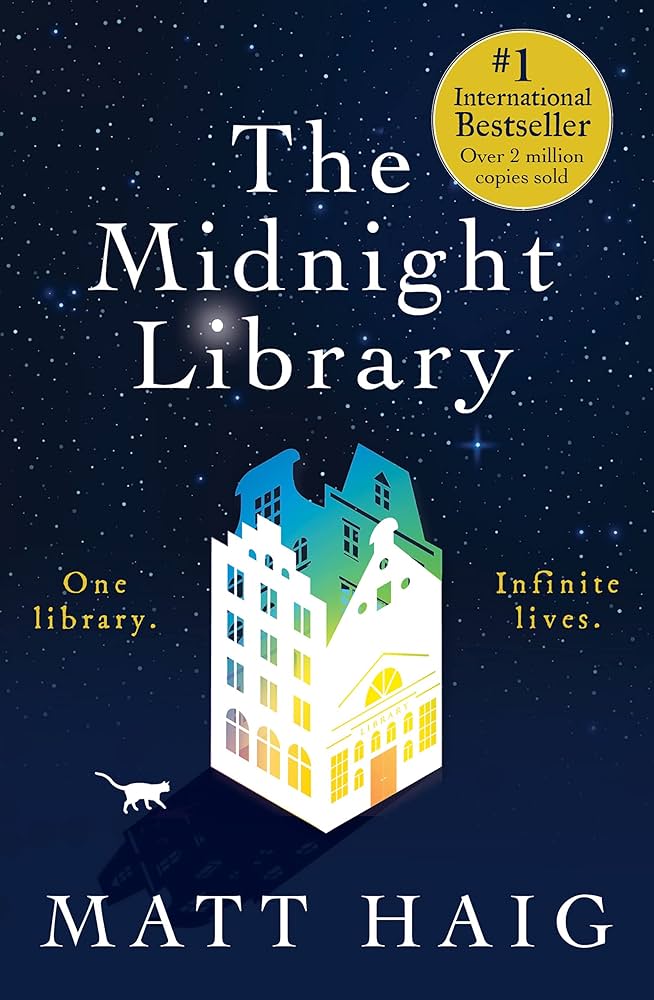
Author: Matt Haig
Genre: Contemporary Fiction / Philosophical Fantasy
Ideal For: Readers who love life-affirming, emotionally resonant novels that blend imagination with introspection. Perfect for fans of reflective fiction, warm storytelling, and books that make you rethink the choices that shaped your life.
Introduction
Matt Haig’s The Midnight Library is one of those rare novels that feels like a hand reaching out from the page — steadying you, comforting you, and reminding you that it’s never too late to rewrite your story. From its haunting opening to its luminous final pages, this book is a triumph of imagination and emotional clarity, earning every bit of its five-star rating.
Haig blends fiction and philosophy with astonishing ease, creating a narrative that’s at once whimsical and deeply grounded in the human heart. It’s a book about regret, but it’s also a book about hope. It’s a meditation on alternative lives, yet unmistakably anchored in the present moment. And above all, it’s a story about Nora Seed — a woman ready to disappear, who instead finds an entire library of reasons to live.
Plot Summary (Spoiler-Free)
When we meet Nora Seed, she’s drowning in regret. Every part of her life feels like a failure: she’s lost her job, her cat has died, her brother no longer speaks to her, and her childhood dreams have evaporated into ordinary disappointment. On one terrible night, Nora decides she has nothing left to live for.
But death isn’t what comes next. Instead, she awakens in a surreal place between life and death: The Midnight Library, a vast space filled with books, each one containing a version of the life she could have lived. Inside this magical library is her old school librarian, Mrs. Elm, who becomes both guide and guardian.
Each book in the library represents a life Nora might have lived if she had made different choices: stayed in her band, pursued glaciology, married her ex-fiancé, kept her swimming career alive, moved cities, said yes, said no… infinite possibilities.
The question becomes:
Which life, if any, will finally show her the meaning of happiness?
Matt Haig’s Voice: Warm, Clear, and Unafraid
Haig writes with a rare blend of empathy and simplicity. His prose is not ornate or showy — it’s intentional. Every line is designed to reach you, to make you feel seen, to let the story breathe.
He understands the internal language of regret. He understands depression from the inside out, but he also knows how to trace a path out of its shadows. Through The Midnight Library, he offers philosophy without pretension, and comfort without condescension.
Haig’s writing feels like a conversation with someone who has lived through darkness and come back bearing light. The emotional intelligence of the novel is its superpower — gentle, unwavering, and subtly transformative.
Why Nora Seed Is One of the Decade’s Most Memorable Protagonists
Nora is compelling because she’s flawed in ways we recognise immediately. She is someone who has spent years trying to live up to others’ expectations — a woman crushed by the weight of “what ifs.” Haig gives her the emotional vocabulary of someone who doesn’t know how to forgive herself.
As she journeys through her alternate lives, Nora becomes more layered, more hopeful, more honest. We watch her confront versions of herself she barely recognises — some successful, some lonely, some deeply fulfilling, and some terrifying.
Her growth is the beating heart of the narrative. She’s not just searching for the “right” life — she’s learning the radical act of choosing herself.
The Midnight Library as a Metaphor
The library is one of the most beautiful metaphors in modern fiction.
It represents:
- The infinite potential inside every moment
- The weight of regret that keeps us from living fully
- The idea that no single life is perfect
- The power we hold to change direction, even in small ways
Each book Nora opens teaches her something new about human longing — about the dangers of idealising alternate versions of ourselves, and the necessity of embracing our messy, imperfect reality.
The Emotional Arc: Gentle, Deep, and Transformative
The novel’s emotional power lies in its gradual shift from despair to possibility. It’s not a rush of positivity. It’s slow, deliberate healing.
We follow Nora through:
- A life where she’s a rock star
- A life where she’s a glaciologist
- A life where she’s a mother
- A life where she’s rich and admired
- A life where she stayed with the man she almost married
- A life where she saved her friendships, her dreams, her family
In each world, she learns that even the most glamorous life carries its own burdens. Joy and pain coexist everywhere. The question is not which life is perfect, but which life feels like home.
This emotional realism is what makes The Midnight Library so profoundly relatable. It’s not magical escapism — it’s magical realism with a purpose.
Themes That Stay With You Long After You Finish Reading
1. Regret as a Universal Human Experience
Everyone has moments they wish they could undo. Haig treats regret not as failure, but as a compass — a way to understand what we value, what we fear, and what we’ve neglected.
2. Mental Health and the Will to Live
Haig’s portrayal of depression is honest but not hopeless. He writes from lived experience, and it shows. The book doesn’t glamorise pain — it acknowledges it, then gently leads the reader toward hope.
3. Choice, Agency, and Self-Compassion
The novel argues that purpose isn’t something we stumble into — it’s something we shape. Nora’s journey is about reclaiming agency.
4. The Myth of the Perfect Life
Every life Nora enters seems ideal from the outside, but none is free of struggle. The story reminds us that comparison is a thief — often of joy, always of truth.
Why This Book Resonates with Millions
The Midnight Library became a global sensation because it meets readers where they are. It speaks to exhaustion, to searching, to the quiet longing for a life that makes sense.
It gently says:
“You are enough. You have always been enough.”
Haig’s novel doesn’t promise a neat, tidy solution to existential crisis — instead, it offers a hopeful framework for rethinking life’s hardest moments. It gives readers permission to start again, even if only in small ways.
A Story That Heals While It Entertains
The beauty of The Midnight Library is how seamlessly it blends narrative and philosophy. You are swept along by the plot, but you are also changed by what it reveals.
It’s rare for a book to feel like both an adventure and a therapy session.
Nora’s eventual realisation — that small moments of connection, joy, and purpose matter more than imagined perfection — hits with quiet force. It’s the kind of message that can shift a person’s perspective, perhaps even save a life.
The Ending: Hopeful, Gentle, and Earned
Without giving spoilers, the ending brings resolution without neatness. It doesn’t erase Nora’s pain — it recontextualises it. Her final decision is empowering because it stems from understanding, not fantasy.
The closing chapters are some of the most beautiful Haig has ever written — a love letter to life’s ordinary wonders.
Why It Deserves Five Stars
- It’s original and emotionally resonant
- It balances philosophical depth with engaging storytelling
- Nora is a protagonist who lingers in your mind
- The writing is warm, accessible, and unforgettable
- The novel offers genuine comfort without clichés
This is one of those rare books that manages to be both universal and deeply personal. It’s a story readers return to during difficult times — a literary companion for anyone questioning their path.
Final Verdict: A Life-Affirming Masterpiece
The Midnight Library is a luminous, compassionate novel that reminds us how precious — and how malleable — our lives truly are. Matt Haig invites us into a world of infinite possibilities, only to lead us gently back to the one possibility that matters most: living fully in the life we already have.
If you’ve ever wished for a second chance, wondered about the road not taken, or longed to understand your place in the world, this book is a gift — one filled with wisdom, heart, and hope.