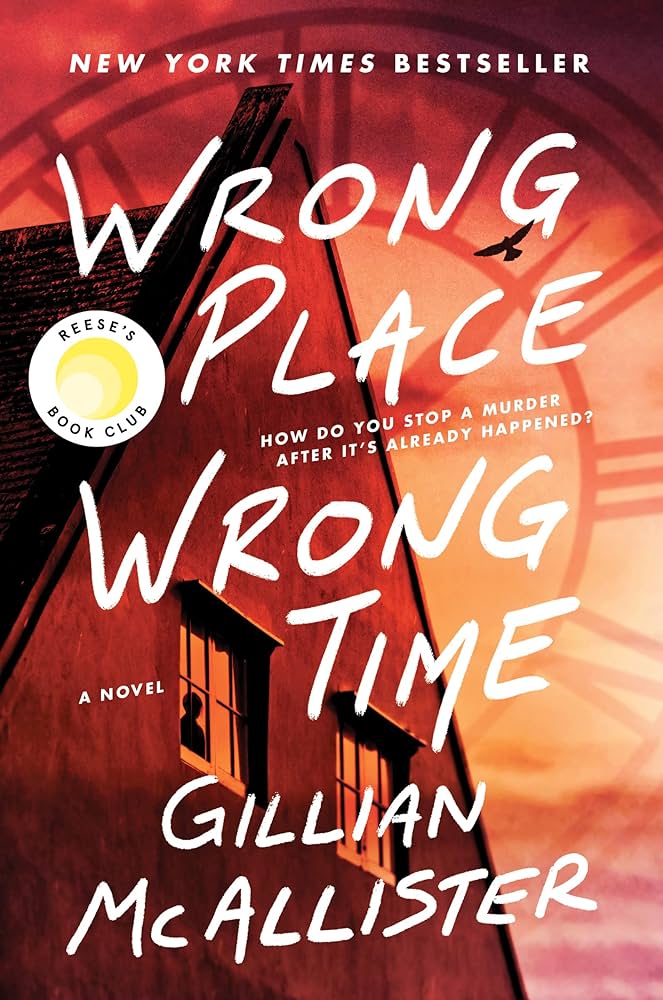
Author: Gillian McAllister
Genre: Psychological Thriller / Time Travel Mystery
Ideal For: Readers who love clever, emotionally charged thrillers that combine suspense with introspection. Perfect for fans of Before I Go to Sleep and The Time Traveler’s Wife, and anyone fascinated by the idea of rewriting fate.
Plot Summary (Spoiler-Free)
Gillian McAllister’s Wrong Place Wrong Time opens on a chilling yet ordinary night — a mother watching from her window as her teenage son commits a murder. It’s an act so shocking and inexplicable that it tears through her world in an instant. But when she wakes up the next morning, time has rewound. The day before the murder has returned. And then another day before that.
Each morning, she wakes further back in time — armed with knowledge of what will happen but powerless to stop it in the usual way. Her only hope is to uncover why it happened. What pushed her son, Todd, to kill? What secrets lie in their family’s carefully constructed life?
From that premise unfolds a breathtaking story about motherhood, morality, and fate — one that turns a thriller into something far more profound. It’s not just a “who done it,” but a “why did it happen,” and perhaps most hauntingly, “can love undo what’s already been done?”
McAllister’s Voice: Intimate, Inventive, and Emotionally Electric
Gillian McAllister’s writing is a masterclass in emotional tension. She manages to make every page pulse with urgency while keeping the narrative deeply human. Her prose is elegant yet propulsive, every sentence crafted with purpose.
She doesn’t rely on jump scares or predictable twists. Instead, she lets the psychological suspense build like a slow-burn symphony — layering regret, maternal love, and ethical complexity. The time-loop premise could easily have become gimmicky, but McAllister uses it as a psychological device rather than a plot trick. Each backward step reveals hidden dimensions of the characters’ lives — the lies told in love, the moments missed in haste, the small decisions that form the architecture of tragedy.
Her perspective is grounded entirely in Jen’s consciousness — and that choice makes the novel devastatingly intimate. You feel her confusion, her grief, her fierce, irrational hope. The time travel isn’t scientific; it’s emotional, almost spiritual. Each leap backward feels like peeling away another layer of guilt and illusion until only truth remains.
The Structure: Ingenious and Unpredictable
The book’s structure mirrors its title — wrong place, wrong time — a pattern of chance and inevitability that keeps the reader disoriented but engaged. Every time Jen wakes up a day earlier, the reader feels both dread and curiosity.
What new clue will emerge? What new secret will upend everything she thought she knew?
McAllister handles these transitions with surgical precision. Time travel narratives often stumble over logic, but here, the mechanics feel seamless — not because they’re scientific, but because they’re emotional. Each reversal feels necessary, like the universe is slowly granting Jen the perspective she never had before.
The pacing is perfectly balanced: breathless in moments of revelation, reflective in quiet domestic scenes. McAllister understands that suspense doesn’t only come from the unknown — it comes from knowing too much, too late.
Themes That Stay With You
1. Motherhood and Guilt
At its core, Wrong Place Wrong Time is about the impossible weight of parental responsibility. Jen’s journey backward in time isn’t just a quest to prevent a crime; it’s a reckoning with every decision she’s made as a mother. Did she protect Todd too much? Did she miss signs she should have seen? The novel captures the haunting realisation that love, even when pure, can blind as easily as it can save.
2. The Nature of Time and Consequence
McAllister explores time as a moral force — not something that flows but something that reveals. In going backward, Jen isn’t escaping her mistakes; she’s confronting them from their roots. Each day takes her closer to the origin of the violence — and closer to the moment she stopped truly seeing her own life.
3. Marriage and Secrets
Beyond motherhood, the book delves into the quiet deceit that can settle into long-term relationships. As Jen travels further into her past, she uncovers not just Todd’s secrets, but her husband’s. McAllister captures the fragility of trust — how even small omissions can accumulate until they fracture a family.
4. Redemption Through Understanding
Unlike most thrillers that hinge on vengeance or justice, Wrong Place Wrong Time is about compassion and clarity. It’s a story about doing the impossible: forgiving yourself for what you didn’t know then — and acting differently once you do.
Characterisation: Real, Raw, and Resonant
Jen is one of the most compelling protagonists in contemporary thrillers. She’s intelligent but fallible, brave but scared, loving but flawed — a fully realised portrait of a woman facing the unthinkable. McAllister resists the trope of the “perfect mother.” Instead, Jen’s strength lies in her willingness to confront her imperfections head-on.
Todd, though initially seen through the lens of his crime, slowly emerges as a deeply sympathetic figure. As Jen unravels the events leading to the murder, the reader comes to see the world through his eyes — the pressures, the fear, the unspoken pain that made him what he is. It’s a powerful reminder that behind every crime lies a human story, often misunderstood.
Even the secondary characters — Ryan, Jen’s husband; Kelly, her best friend; and the various figures in Todd’s orbit — are written with subtlety. Each plays a role in the emotional web that McAllister so expertly spins.
Why the Time-Loop Device Works Perfectly
Time travel in thrillers can feel risky. It often stretches believability or distracts from emotional truth. But here, it functions as metaphor. The backward movement becomes a way of examining memory — how we replay events in our heads, wishing we’d noticed what we missed.
Every reversal forces Jen (and us) to confront how life is built out of unnoticed turning points. A text not sent. A conversation cut short. A moment of defensiveness instead of openness. The time loop gives her — and by extension, the reader — the impossible gift: to go back, not to change fate, but to understand it.
That’s what makes this book so powerful. It’s not science fiction; it’s emotional realism dressed in speculative clothing.
The Writing: Sharp, Cinematic, and Beautifully Human
McAllister’s prose is tight and precise, yet deeply lyrical in the quiet moments. Her ability to balance tension with tenderness gives the novel an almost cinematic texture. You can see every scene — the cold streetlight, the trembling hand, the clock ticking backward.
But beyond imagery, it’s her psychological depth that lingers. Her descriptions of motherhood are some of the most nuanced in recent fiction — not sentimental, but painfully honest. She captures the claustrophobic blend of love, fear, and exhaustion that defines parenting, especially when everything goes wrong.
What Makes It a Five-Star Read
- Originality: A time-loop thriller told with psychological and emotional realism — a rare combination that works flawlessly.
- Emotional Impact: It’s suspenseful, yes, but also profoundly moving. The stakes aren’t just about solving a crime; they’re about saving a family.
- Structure: The reverse chronology is executed with precision — never confusing, always revelatory.
- Character Depth: Jen feels so real you want to reach through the pages to comfort her.
- Writing Quality: Elegant, cinematic, and gripping from start to finish.
This is the kind of book that makes you question your own life — the small choices that shape everything, the people you love most but sometimes fail to see clearly.
The Ending: Poignant, Satisfying, and Worth Every Page
Without revealing spoilers, the ending delivers emotional closure and narrative satisfaction in equal measure. It doesn’t rely on shock value but on revelation — that quiet moment when all the pieces click, and you realise what it truly means to change the past. McAllister ties every thread with grace, offering not only suspense but redemption.
When you close the final page, you’ll likely sit still for a moment — thinking about your own family, your own missed signs, and the thin line between right moment and wrong time.
Final Thoughts: A Masterpiece of Psychological Suspense
Wrong Place Wrong Time is the rare thriller that transcends its genre. It’s part domestic drama, part speculative fiction, part love story between a mother and her son. Gillian McAllister has crafted a narrative so emotionally intelligent that it feels almost therapeutic.
It reminds us that love isn’t about control — it’s about understanding. That time, cruel as it can be, sometimes offers us what we need most: perspective.
This is not just a page-turner; it’s a soul-turner. A story that lingers long after you’ve finished, reshaping how you see your own life and choices.
Verdict:
⭐️⭐️⭐️⭐️⭐️ — A masterpiece of empathy, suspense, and storytelling brilliance.
Gillian McAllister turns the impossible into the inevitable, the unbelievable into the unforgettable. Wrong Place Wrong Time isn’t just one of the best thrillers of the decade — it’s one of the most humane.